
A scale-out network wires thousands of racks — row upon row across a floor — into a single AI cluster, tied together by hundreds of thousands of optical links. Marvell builds the interconnect silicon and switching at the heart of that fabric, matched to every link within it.
To build a modern AI cluster, row upon row of racks have to be wired together into one fabric — thousands of them, under one roof, moving data east to west between accelerators at the heart of every training run and every large inference job. That fabric is scale out. It sits between scale up, which tightly couples accelerators into a single compute domain, and scale across, which connects separate data centers. Scale out is the tier that turns a room full of racks into one machine.
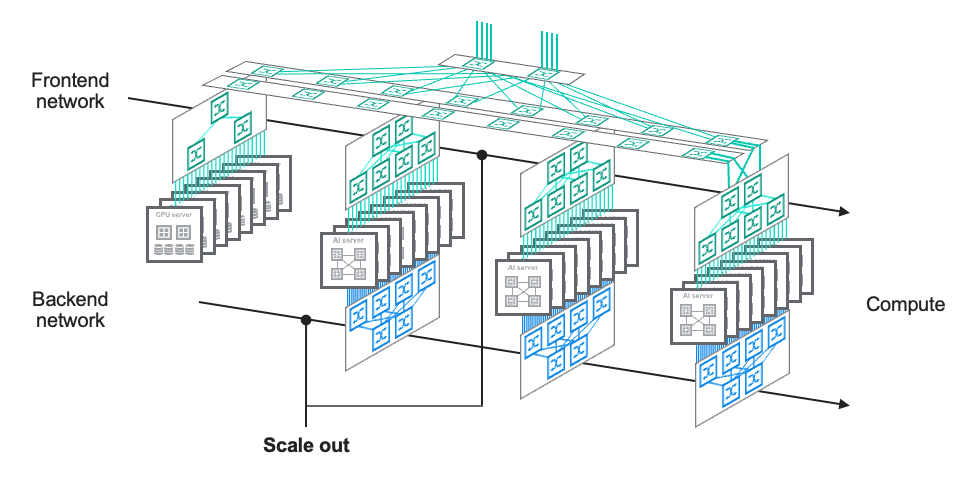
Scale out is the connectivity that links racks across many rows into a single AI cluster within a data center. It’s the east-west fabric that lets thousands of accelerators work as one.
Interconnects carry the data; switching ties them into a fabric. These are the two pillars of connectivity. The switch at the center sets the power, latency, and shape of the entire cluster.
Distributed AI workloads rely on frequent, high-volume communication between compute nodes. Training large models and serving distributed inference pipelines generate sustained east-west traffic that places heavy demands on network infrastructure.
As clusters scale to hundreds of thousands or millions of accelerators, networks must support:

The Marvell® Teralynx® T100 switch is designed to address these challenges. Its the industry's first at 102.4 Tbps that’s built specifically for the AI era. Where legacy switch architectures carry the overhead of the enterprise and cloud networks they were designed for, the T100 switch is a monolithic 102.4T device on 3nm that strips that overhead out — delivering up to 25% lower power than competitive solutions and the industry's lowest latency at this bandwidth tier, at under 1000W typical power consumption.
That efficiency is a scaling lever. As GPU and XPU racks approach 120kW, switching consumes an estimated 15–25% of rack power, so a lower-power switch lets operators place more accelerators inside the same power envelope. And with a 512-port radix, the T100 switch flattens the fabric: fewer tiers, fewer optical hops, lower latency and lower TCO across clusters of tens of thousands of accelerators.

One connected foundation, from copper between racks to optics across the floor, to the network switches that make the fabric:
Optical interconnect silicon
Copper and optical cables
Ethernet switching
Telemetry

Learn More
Learn More

Learn More

Scale up tightly couples accelerators into a single compute domain — within a rack, and increasingly across a few racks. Scale out connects many such domains — row upon row of racks across a floor — into one cluster. Scale across connects separate data centers. Scale up makes many accelerators act as one domain, while scale out ties many domains into a cluster.
Ultra Ethernet is the Ultra Ethernet Consortium (UEC) standard that adapts Ethernet for AI and HPC fabrics, adding the congestion management, telemetry, and transport features distributed AI training needs. It keeps scale-out open and multi-vendor while closing the performance gap with proprietary fabrics. The Marvell Teralynx T100 switch is built for the latest Ultra Ethernet Consortium standards.
Marvell builds the silicon across the whole scale-out fabric, both the interconnect and the switching. That spans PAM4 optical DSPs, coherent-lite DSP, TIAs, drivers, and optical engines across every module and cable format; AEC and AOC copper-and-optical cable silicon; Teralynx Ethernet switches built for Ultra Ethernet; and the RELIANT interconnect telemetry platform.
Scale out is the connectivity that links racks across many rows into a single AI cluster within a data center. It's the east-west fabric — often hundreds of thousands of links — that lets thousands or even hundreds off thousands of accelerators communicate and work as one during training and large-scale inference.
Scale up tightly couples accelerators into a single compute domain — within a rack, and increasingly across a few racks. Scale out connects many such domains — row upon row of racks across a floor — into one cluster. Scale across connects separate data centers. Scale up makes many accelerators act as one domain, while scale out ties many domains into a cluster.
A range, because the links aren't all the same. Copper cables (ACC, AEC) for the shortest rack-to-rack links; active optical cables (AOC) just beyond copper's reach; and pluggable optics in transmit-retimed (TRO), full-retimed (FRO) and linear (LPO) formats for longer links. Near-package optics (NPO) and co-packaged (CPO) optics offer maximum density at the switch. Marvell builds silicon across the entire range.
The Marvell view is that pluggable optical modules will lead scale-out connectivity for the next decade. Pluggables are the only interconnect that can scale fast enough to meet immediate AI bandwidth demand, and they let operators service, mix, and upgrade the fabric link by link. Co-packaged optics have a role at the highest densities, and Marvell builds CPO silicon too, but its natural home is the shortest, densest links of scale up.
High-radix switches reduce hop count and improve bandwidth utilization, simplifying network topology as clusters grow.
Ethernet is open, multi-vendor, and scaling fast for AI through the Ultra Ethernet Consortium. It lets operators build large fabrics without locking into a single vendor. The Marvell Teralynx T100 switch brings 102.4T of purpose-built, low-power Ethernet switching to that fabric.
The full connectivity stack: PAM4 optical DSPs, coherent-lite DSPs, TIAs, drivers, and optical engines across every module and cable format; AEC and AOC cable silicon; Teralynx Ethernet switching; and the RELIANT interconnect telemetry platform matched to every link in the fabric.
We believe better partnerships help to build better technologies. Let’s connect and see what we can design together!
We will be in touch with you soon!


