
As AI workloads continue to scale in size and complexity, modern AI clusters are expanding from thousands to hundreds of thousands and increasingly millions of interconnected accelerators operating across large distributed environments. The growth of large language models (LLMs), expanding parameter counts, longer context windows, and rising token processing demands are driving unprecedented requirements for bandwidth, latency, and coordinated data movement at cluster scale.
Scale-out networking provides the connectivity fabric that enables these massive AI systems to operate as coordinated infrastructures, efficiently moving data across distributed compute, memory, and network resources. By prioritizing bandwidth, scalability, reach, and power efficiency, scale-out networking enables modern AI workloads to scale across increasingly large data center environments.

Distributed AI workloads rely on frequent, high-volume communication between compute nodes. Training large models and serving distributed inference pipelines generate sustained east-west traffic that places heavy demands on network infrastructure.
As clusters scale to hundreds of thousands or millions of accelerators, networks must support:
Without purpose-built scale-out networking, performance and efficiency degrade rapidly as cluster size increases.

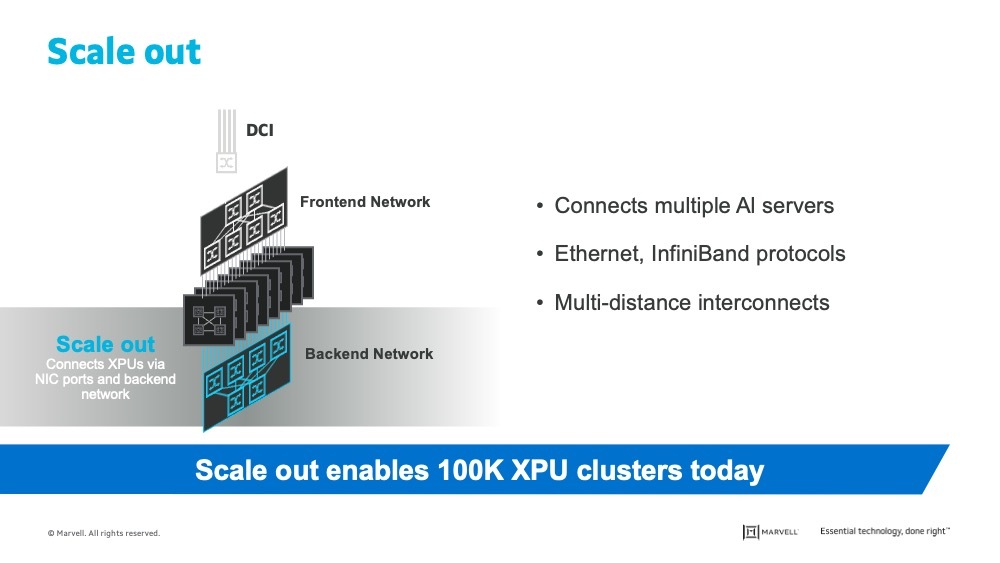
Scale-out networking refers to the interconnect fabric that links multiple systems into a distributed AI cluster. Unlike scale-up connectivity, which tightly couples resources within servers or racks, scale-out networking is designed to support reach, parallelism, and growth across many independent nodes.
Scale-out networks connect large numbers of accelerators across racks and data halls, enabling AI workloads to scale beyond the limits of a single system.
Scale-out networks are defined by several architectural requirements:
These characteristics distinguish scale-out networking from node-level and rack-level interconnects.
High-speed Electrical and Optical Links
As link speeds increase and AI clusters scale from thousands to millions of accelerators, scale-out networks rely on advanced signaling technologies such as PAM4 optical connectivity to deliver the bandwidth density, reach, and power efficiency required for modern AI infrastructure operating at 400G, 800G, 1.6T, and emerging next generation 3.2T speeds.
High-radix Switching and AI Fabrics
Large AI clusters require scalable switching architectures capable of efficiently connecting massive numbers of endpoints across distributed infrastructure. High-radix switching platforms reduce hop count, improve bandwidth utilization, and simplify AI fabric topology as clusters continue to scale.
Emerging AI fabric standards and architectures, including Ultra Ethernet (UEC), adaptive routing, congestion management, and advanced traffic control mechanisms—are helping improve network efficiency, resiliency, and predictable performance across large-scale AI deployments.
Network Topology, Telemetry, and Traffic Optimization
Scale-out networks must support collective communication patterns common in AI training and distributed inference workloads. As AI jobs increasingly run for days or weeks across extremely large clusters, telemetry, network visibility, and real-time analytics become critical for maintaining efficient and reliable operation.
Topology design, adaptive traffic optimization, congestion management, and telemetry platforms such as Marvell RELIANT™ help operators monitor AI fabric behavior, improve workload efficiency, reduce bottlenecks, and maintain predictable performance at scale.
Emerging Optical Scale-Out Architectures
As networks transition from 800G to 1.6T connectivity and toward emerging 3.2T architectures, new requirements for bandwidth density, signal integrity, power efficiency, and optical scalability are reshaping scale-out network design. Emerging architectures such as optical circuit switching enable direct, low-latency optical paths across large-scale AI fabrics, improving scalability, network efficiency, and infrastructure utilization.
Scale-out networking is used across multiple layers of AI infrastructure, including:
When AI infrastructure expands beyond a single data center, networking requirements shift toward inter-site connectivity.
Scale-out networking is one of several architectural approaches used to scale AI infrastructure. Scale-out networking integrates with scale-up fabrics such as PCIe and CXL to enable efficient communication, memory access, and resource sharing across large AI clusters.
The table below summarizes how networking behaves in each AI scaling model, from local scaling connectivity inside packages to scale across inter site links.
| AI Scaling Model | Role of Networking | ||
|---|---|---|---|
| Scale Up | Low-latency fabrics within servers and racks | ||
| Scale Out | High-bandwidth networks connecting clusters | ||
| Scale Across | Long-reach inter-site connectivity |
Scale-out networking often works alongside scale-up connectivity.
Effective scale-out networking enables:
Scale-out networking does not operate in isolation. Its effectiveness depends on coordination across:
Platform-level co-design ensures networking capabilities align with overall system goals.
Common applications include:
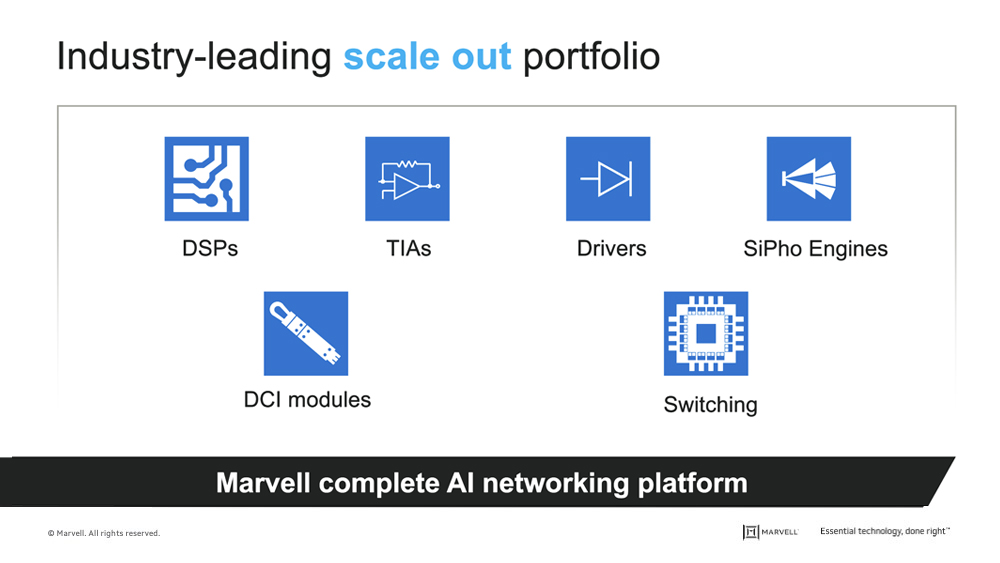
Marvell provides platform technologies used in scale-out AI networking fabrics, including:
Data Center Switching Platforms
High-Speed Interconnect and Optical Platforms

Scaling AI infrastructure is a foundational challenge for modern data centers. Scale out and scale across provide a structured framework for understanding how AI systems expand across chips, nodes, data centers, and regions. As AI workloads continue to grow, future infrastructure will increasingly depend on advanced interconnect technologies, platform level co design, and holistic approaches that treat scale as a core architectural principle.
Scale-out networking is the interconnect fabric that connects multiple systems into a distributed AI cluster, enabling high-bandwidth communication across racks and data halls.
Scale-up connectivity tightly couples components within servers and racks, while scale-out networking connects many independent nodes across a data center.
Optical connectivity enables higher data rates and longer reach with improved power efficiency, which is critical for large AI clusters.
High-radix switches reduce hop count and improve bandwidth utilization, simplifying network topology as clusters grow.
Scale-out networking is deployed across racks, rows, data halls and large AI clusters within a data center.
Scale-out networking enables hundreds of thousands of distributed GPUs and accelerators to efficiently communicate and synchronize massive AI models and datasets across large-scale AI clusters.
Distributed inference platforms benefit from scale-out networking when workloads are spread across multiple systems or shared infrastructure.
We believe better partnerships help to build better technologies. Let’s connect and see what we can design together!
We will be in touch with you soon!