



By Sree Durbha, Head of Smart-Connected Business, Marvell
 The consumer drone market has expanded greatly over the last few years, with almost 3 million units shipped during 2017. This upward trend is likely to continue. Analyst firm Statista forecasts that the commercial drone business will be worth $6.4 billion annually by 2020, while Global Market Insights has predicted that the worldwide drone market will grow to $17 billion (with the consumer category accounting for $9 billion of that). As new products are continually being introduced into what is already an acutely overcrowded marketplace, a differentiated offering is therefore critical to a successful product.
One of the newest and most exciting entrants into this crowded drone market, Tello, features functionality that sets it apart from rival offerings. Tello is manufactured by Shenzhen-based start-up Ryze Tech, a subsidiary of well-known brand DJI, which is the world’s largest producer of drones and unmanned aerial vehicles (UAVs). With a 13 minute runtime, plus a flight distance of up to 100 meters, this is an extremely maneuverable and compact quadcopter drone. It weighs just 80 grams and can fit into the palm of a typical teenager’s hand (with dimensions of 98 x 92.5 x 41 millimeters). The two main goals of the Tello are fun and education. To that end, a smartphone App-based control provides a fun user interface for everyone, including young people, to play with. The educational goal is met through an easy to program visual layout that allows users to write their own code using the comprehensive software development kit (SDK) included in the package. What really distinguishes Tello from other drones, however, is the breadth of its imaging capabilities - and this is where engaging with Marvell has proven pivotal.
Tello’s original drone design requirement called for livestreaming 720p MP4 format video, using its 5 Megapixel image sensor, back to the user’s smartphone or tablet even while traveling at its maximum speed of 8 meters/second. This called for interoperability testing with a broad array of smartphone and tablet models. Due to its small size, conserving battery life would be a key requirement, which meant ultra-low power consumption by Wi-Fi®. Underlying all of this was the singular requirement for a strong wireless connection to be maintained at all times. Finally, as is always the case, Wi-Fi would need to fit in the low bill of materials for the product.
Initial discussions between technical teams at Ryze and Marvell revealed a perfect match between the features offered on the Marvell® 1x1 802.11n single-band Wi-Fi system-on-chip (SoC) and the Wi-Fi requirements for the Tello drone project. This chip was already widely adopted in the market and established itself as a proven solution for various customer applications, including video transmission in IP cameras, mobile routers, IoT gateways etc. Ryze chose this chipset, banking on its reliability while transmitting high-definition video over the air, exceptional RF performance over range while offering ultra-low power operation, all at a competitive price point.
Marvell’s Wi-Fi SoC is a highly integrated, single-band (2.4GHz) IC that delivers IEEE® 802.11b/g/n operation in a single spatial stream (1 SS) configuration. It incorporates a power amplifier (PA), a low noise amplifier (LNA) and a transmit/receive switch. Quality of Service (QoS) is guaranteed through the 802.11e standard implementation. The Wi-Fi SoC’s compliance with the 802.11i security protocol, plus built-in wired equivalent privacy (WEP) algorithms, enable 128-bit encryption of transmitted data, thereby protecting the data from being intercepted by third parties. All of these hardware features are supported by Marvell’s robust Wi-Fi software, which includes a small footprint and full featured Wi-Fi firmware tied in with the hardware level features. Specific features such as infrastructure mode operation were developed to enable the functionality desired by Ryze for the Tello.
Marvell’s industry-leading Wi-Fi technology has enabled an exciting new user experience in the Tello, at a level of sophistication that previously would only have been seen in expensive, professional-grade equipment. In order to bring this professional quality experience to an entry-level drone model meant that significant power, performance and cost barriers were overcome. As we enter the 802.11ax era of Wi-Fi industry transition, expect Marvell to launch first-to-market, ever more envelope-pushing, technological advances such as uplink OFDMA.
By Ran Gu, Marketing Director of Switching Product Line, Marvell
Due to ongoing technological progression and underlying market dynamics, Gigabit Ethernet (GbE) technology with 10 Gigabit uplink speeds is starting to proliferate into the networking infrastructure across a multitude of different applications where elevated levels of connectivity are needed: SMB switch hardware, industrial switching hardware, SOHO routers, enterprise gateways and uCPEs, to name a few. The new Marvell® Link Street™ 88E6393X, which has a broad array of functionality, scalability and cost-effectiveness, provides a compelling switch IC solution with the scope to serve multiple industry sectors.
The 88E6393X switch IC incorporates both 1000BASE-T PHY and 10 Gbps fiber port capabilities, while requiring only 60% of the power budget necessitated by competing solutions. Despite its compact package, this new switch IC offers 8 triple speed (10/100/1000) Ethernet ports, plus 3 XFI/SFI ports, and has a built-in 200 MHz microprocessor. Its SFI support means that the switch can connect to a fiber module without the need to include an external PHY - thereby saving space and bill-of-materials (BoM) costs, as well as simplifying the design. It complies with the IEEE 802.1BR port extension standard and can also play a pivotal role in lowering the management overhead and keeping operational expenditures (OPEX) in check. In addition, it includes L3 routing support for IP forwarding purposes. 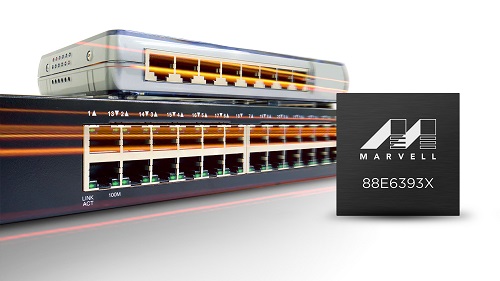 Adherence to the latest time sensitive networking (TSN) protocols (such as 802.1AS, 802.1Qat, 802.1Qav and 802.1Qbv) enables delivery of the low latency operation mandated by industrial networks. The 256 entry ternary content-addressable memory (TCAM) allows for real-time, deep packet inspection (DPI) and policing of the data content being transported over the network (with access control and policy control lists being referenced). The denial of service (DoS) prevention mechanism is able to detect illegal packets and mitigate the security threat of DoS attacks.
The 88E6393X device, working in conjunction with a high performance ARMADA® network processing system-on-chip (SoC), can offload some of the packet processing activities so that the CPU’s bandwidth can be better focused on higher level activities. Data integrity is upheld, thanks to the quality of service (QoS) support across 8 traffic classes. In addition, the switch IC presents a scalable solution. The 10 Gbps interfaces provide non-blocking uplink to make it possible to cascade several units together, thus creating higher port count switches (16, 24, etc.).
This new product release features a combination of small footprint, lower power consumption, extensive security and inherent flexibility to bring a highly effective switch IC solution for the SMB, enterprise, industrial and uCPE space.