


By Vienna Alexander, Marketing Content Professional, Marvell
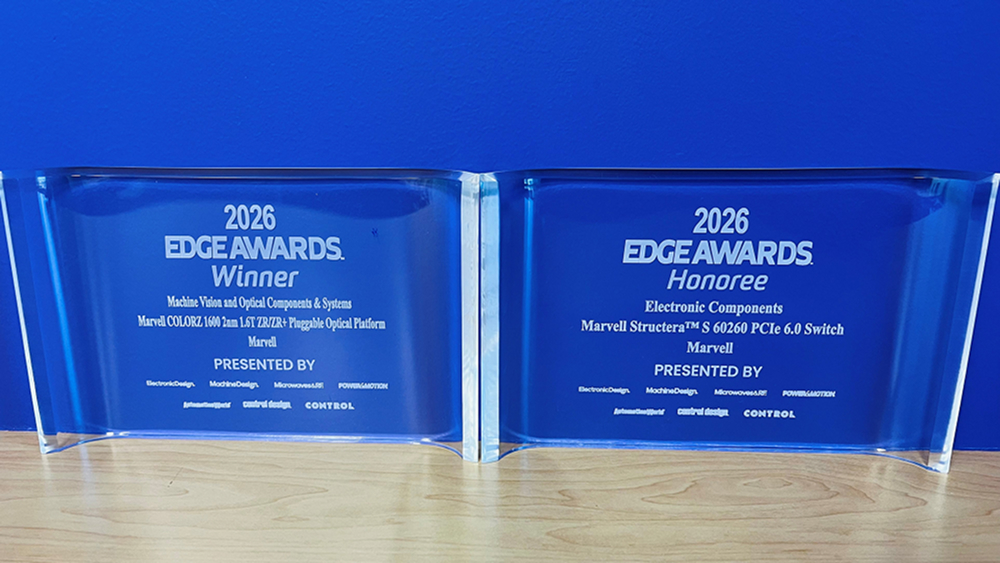
In the 2026 EDGE awards, the Marvell® COLORZ® 1600 2nm 1.6T ZR/ZR+ pluggable optical platform won the Machine Vision and Optical Components & Systems category.
Electronic Design presented this year’s winners and honorees to celebrate recent design and engineering feats that excel in the industry. These innovations are pushing the bounds and represent the leading “EDGE” of technology.
Marvell COLORZ 1600 is the industry’s first 1.6T ZR/ZR+ data center interconnect (DCI) pluggable. Powered by Marvell Electra, the industry’s first 2nm 1.6T ZR/ZR+ coherent DSP, the device delivers efficient, high-performance and secure optical transmission for hyperscale AI and cloud networks globally. The pluggable is purpose-built for long-distance links; COLORZ 1600 connects campus (20km), metro (120km) and regional (1,000km) data centers at 1.6T.
By Arifur Rahman, Director of Product Marketing, Custom Cloud Solutions, Marvell
Modern AI workloads are insatiable consumers of memory. Deep learning recommendation models (DLRM), large language model (LLM) inference, in-memory databases and vector search engines all share a common bottleneck: there is never enough DRAM, and what exists is very expensive.
At today's spot prices—$27–$37 per GB for server-grade DDR5 RDIMMs1—a 12TB memory pool requires nearly half a million dollars in DRAM alone. Meanwhile, AI infrastructure buildouts are consuming server DRAM capacity faster than fabs can produce it, driving prices up 300–400% since mid-2025.1, 2
CXL memory expansion was supposed to solve this. And it does—but there's a subtler lever that most solutions ignore: the data sitting in that memory is compressible, and most CXL controllers don't touch it.
By Claudia Hoessbacher, Senior Director, and Wolfgang Heni, Director, Optical Engineering, Marvell
Plasmons have been used to accelerate drug discovery, enhance the sensitivity of sensors and even create artistic treasures in the Roman era.
Ongoing research at Marvell seeks to harness them to improve the performance of optical networks for the AI era. Plasmonics, a technology that leverages the properties of surface plasmon polaritons (SPPs), provides a promising pathway for enhancing the roadmap of silicon photonic (SiPho) light engines, a critical component inside optical modules.
Plasmonic-based SiPho light engines could support modules operating at 3.2T and beyond while consuming a fraction of the space and power per bit of modules based on existing technologies. Manufacturers could leverage foundry process technologies for scaling production.
By Michael Kanellos, Head of Influencer Relations, Marvell
Data infrastructure needs more: more capacity, speed, efficiency, bandwidth and, ultimately, more data centers. The number of data centers owned by the top four cloud operators has grown by 73% since 20201, while total worldwide data center capacity is expected to double to 79 megawatts (MW) in the near future2.
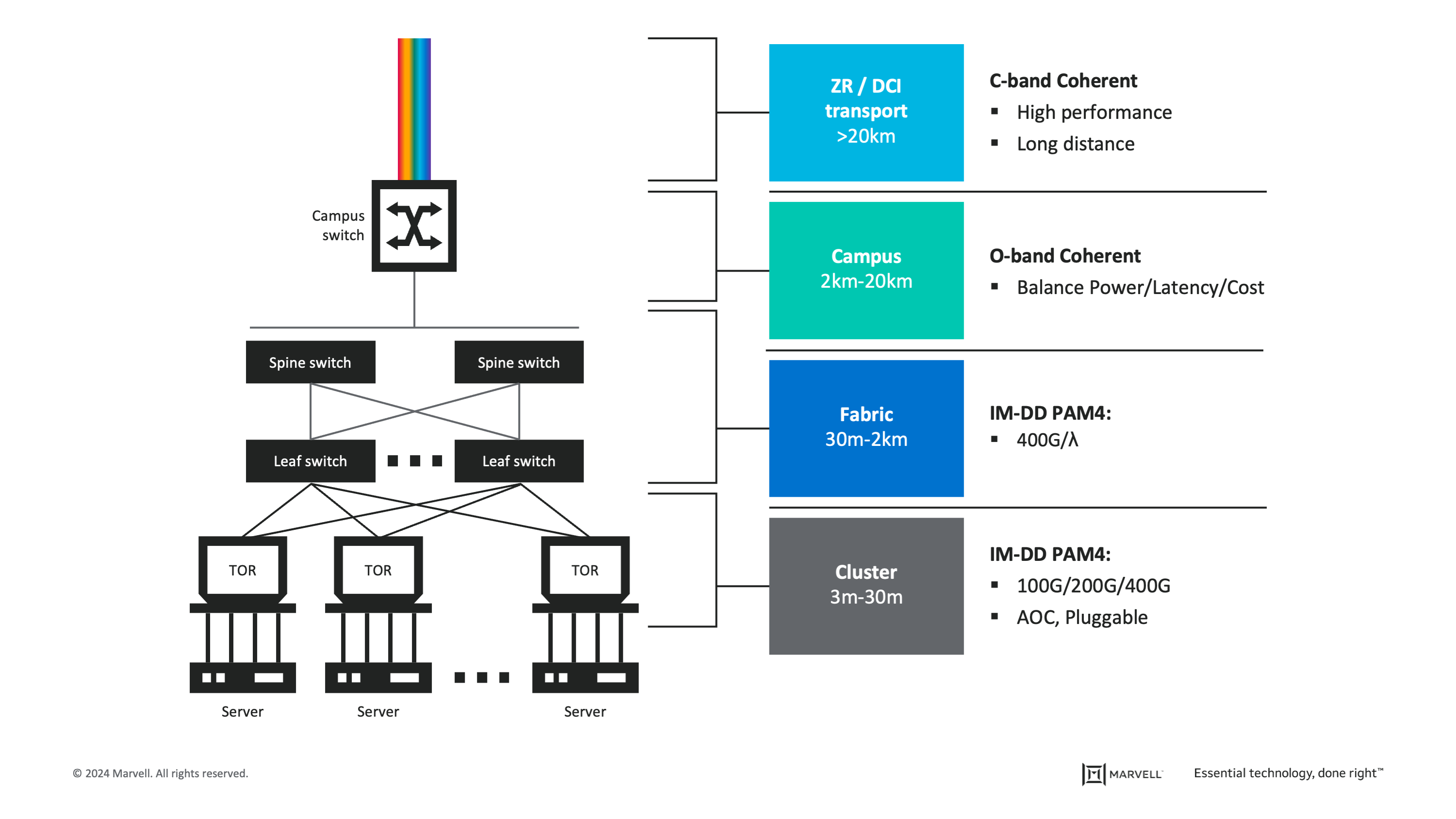
Aquila, the industry’s first O-band coherent DSP, marks a new chapter in optical technology. O-band optics lower the power consumption and complexity of optical modules for links ranging from two to 20 kilometers. O-band modules are longer in reach than PAM4-based optical modules used inside data centers and shorter than C-band and L-band coherent modules. They provide users with an optimized solution for the growing number of data center campuses emerging to manage the expected AI data traffic.
Take a deep dive into our O-band technology with Xi Wang’s blog, O-Band Coherent, An Idea Whose Time is (Nearly) Here, originally published in March, below:
O-Band Coherent: An Idea Whose Time Is (Nearly) Here
By Xi Wang, Vice President of Product Marketing of Optical Connectivity, Marvell
Over the last 20 years, data rates for optical technology have climbed 1000x while power per bit has declined by 100x, a stunning trajectory that in many ways paved the way for the cloud, mobile Internet and streaming media.
AI represents the next inflection point in bandwidth demand. Servers powered by AI accelerators and GPUs have far greater bandwidth needs than typical cloud servers: seven high-end GPUs alone can max out a switch that ordinarily can handle 500 cloud two-processor servers. Just as important, demand for AI services, and higher-value AI services such as medical imaging or predictive maintenance, will further drive the need for more bandwidth. The AI market alone is expected to reach $407 billion by 2027.
By Xi Wang, VP of Product Marketing of Optical Connectivity, Marvell
Over the last 20 years, data rates for optical technology have climbed 1000x while power per bit has declined by 100x, a stunning trajectory that in many ways paved the way for the cloud, mobile Internet and streaming media.
AI represents the next inflection point in bandwidth demand. Servers powered by AI accelerators and GPUs have far greater bandwidth needs than typical cloud servers: seven high-end GPUs alone can max out a switch that ordinarily can handle 500 cloud two-processor servers. Just as important, demand for AI services, and higher-value AI services such as medical imaging or predictive maintenance, will further drive the need for more bandwidth. The AI market alone is expected to reach $407 billion by 2027.
O-band coherent or coherent lite—a technology that has been discussed for years at conferences but has yet to be deployed commercially in a meaningful way--will likely begin to percolate into the market over the next few years to help cloud service providers accommodate some of these challenges.