


By Andrew Yick, Technical Associate Vice President, Operations Engineering, Marvell
This article was first published in Photonic Integrated Circuits magazine.
The dominant challenge in modern AI infrastructure is not just the performance of a single accelerator but scaling up to thousands of accelerators (XPUs) in a cluster. Training and inference workloads now depend on an interconnect that can stitch these accelerators into a high-bandwidth, low-latency system, where performance is governed as much by the network as by the compute itself.
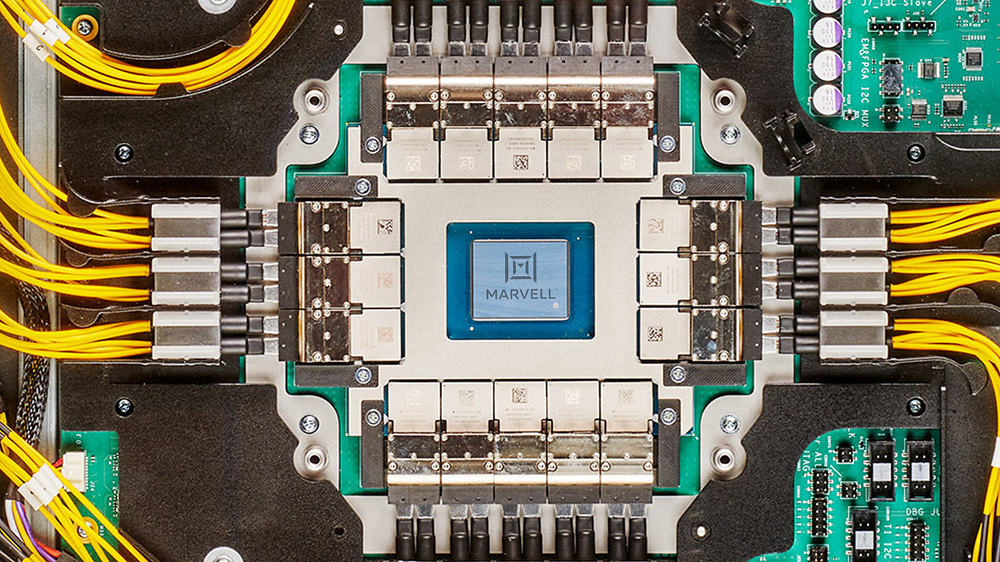
As these systems scale, physics asserts itself. Electrical links over copper hit a practical ceiling as routing density and channel loss collide, turning the loss bandwidth product into an impassable constraint. The choice is binary: either move electrical-to-optical conversion closer to the Application-Specific Integrated Circuit (ASIC) or surrender the link budget. Thus, to bypass this electrical wall, optics must migrate from the board edge and onto the ASIC package.
By Preet Virk, Senior Vice President and General Manager, Photonic Fabric Business Unit
Modern AI infrastructure is built around multi-rack systems where thousands to tens of thousands of accelerators operate as a single logical compute element. As agentic AI and Mixture of Experts (MoE) models accelerate AI adoption, they are driving unprecedented scale and communication demands across data center infrastructure. These systems are connected by scale-up and scale-out networks that must deliver high bandwidth, low latency and efficient power. As these networks extend across racks, maintaining that performance becomes a primary challenge.
As AI systems grow in complexity and scale, the network becomes the backbone of the compute system. Large-scale clusters require massive XPU-to-XPU communication, driving an evolution beyond legacy protocols like PCIe® to encompass UALink™ (Ultra Accelerator Link), ESUN (Ethernet scale-up networking) and NVLink.
Meeting these requirements demands a new approach to connectivity. Marvell provides a comprehensive AI connectivity portfolio spanning scale-up, scale-out, scale-across and DCI (data center interconnect) network architectures. For scale-up networking, Marvell delivers copper and optical interconnects connecting XPUs, switches and memory. Within the rack, Marvell copper solutions provide low-latency, power-efficient short-reach connectivity, while Marvell optical interconnects enable high-performance scaling beyond the rack. This enables XPUs to operate as a more efficient, unified system as scale-up domains expand.
By Rohan Gandhi, Product Marketing Manager, Optical and Copper Connectivity
When the London Underground opened its first line in 1863, a group of doubtful dignitaries boarded a lurching, smoke-belching train for history’s inaugural subway ride. The next day, thirty thousand curious Londoners flooded the nascent system, and within a year, more than nine million had embraced its use. Nearly 160 years later, that original tunnel is still in daily use, joining 250 miles of track that carry more than 1.3 billion passengers annually.
What were the keys to such extraordinary growth? Not just popular demand for more tunnels, but also better use of accumulated infrastructure – optimized through newer trains, enhanced signaling, greater energy efficiency, and smarter scheduling. In a sense, the Tube’s transformation mirrors the fundamental challenge now confronting modern data centers: how to make better use of existing infrastructure to handle today’s exponential growth of data.
PAM4 DSP Technology is Fast and Flexible
To keep up with the surging data demands of new video and AI workloads, modern data centers can’t simply add more and bigger pipes – at least not cost-effectively. They need PAM4 based optical module solutions to effectively and efficiently move more bandwidth at higher speeds. In addition, they need to be able to update the optical modules via software, optimizing existing infrastructure at an affordable price.