

AI and confidential-compute workloads are scaling cryptographic demand faster than centralized HSMs (hardware security modules) can handle. With a centralized HSM, every operation you want to do has to be a network roundtrip from where your workload is to the centralized HSM and back. This process causes latency and scaling bottlenecks, and even an expanded attack surface, making systems and their data more vulnerable to hacking and leaking.
Under pressure to meet performance targets, teams start to compromise and put in workarounds. These workarounds—not HSMs—erode trust and security. A CVM (confidential VM) enclave where certificates and keys live in plain text in enclaves is vulnerable. VM Memory encryption does not mean that keys remain encrypted during application use within the VM. A dedicated HSM is needed.
Often in existing systems, critical keys are being generated outside of the centralized HSM boundary for convenience. They want to be where the workload is, and the same applies for keys being exported into environments that have weaker assurances. Another workaround to optimize performance is introducing local key caches, but again that erodes security by bypassing some of the security and isolation that the HSM offers. Keys are moving around different environments and different vendors, going from one cloud to another, often causing opportunities for keys to leak. The HSM is a secure fortress that provides an extra layer of security, but that is also causing scaling bottlenecks.
To address this challenge, Microsoft, Marvell and Oracle introduced Tessera Integrated HSM. Leveraging Microsoft Azure Integrated HSM and cloud scale deployment; Marvell® LiquidSecurity® HSM silicon and firmware; and Oracle Cloud Infrastructure Key Management, the solution brings the best from all three. This local HSM on the tray co-located with the workload provides the same isolation and security that you want in a cloud HSM but being local to the tray minimizes latency and increases system performance, eliminating the need for risky workarounds.
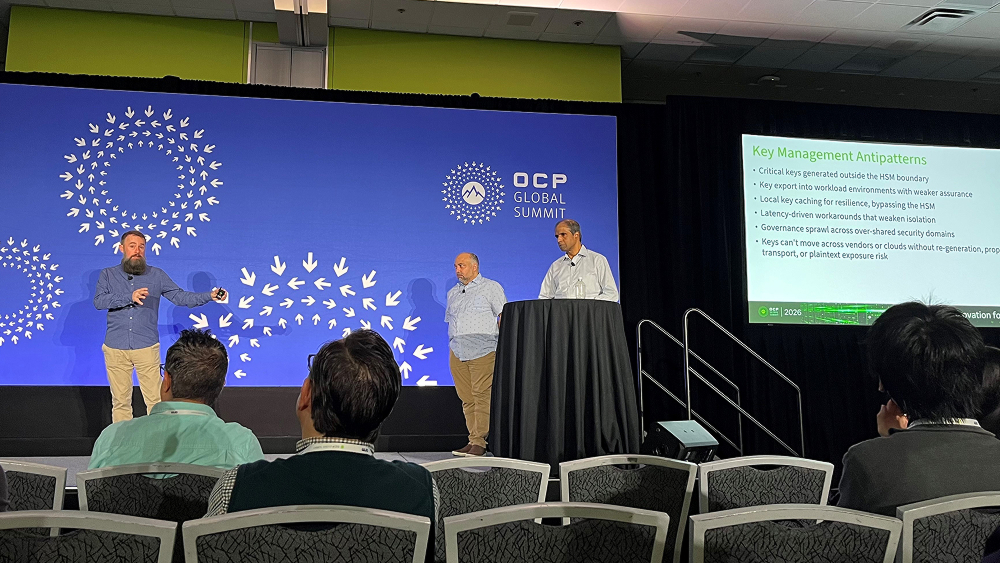
Craig Barner (Marvell), Vishal Soni (Microsoft) and Mohan Kumar (Oracle) give a presentation about Tessera at the OCP Global Summit.
The name Tessera derives from the tessera hospitalis, an ancient token used to establish trust and grant privileged access. Often broken into two matching halves, the unique fracture served as a form of identity verification, with authenticity proven when the pieces were reunited. In today's AI era, where digital tokens are central to access and transactions, and HSMs provide the trust foundation that protects them, the name Tessera feels especially fitting.
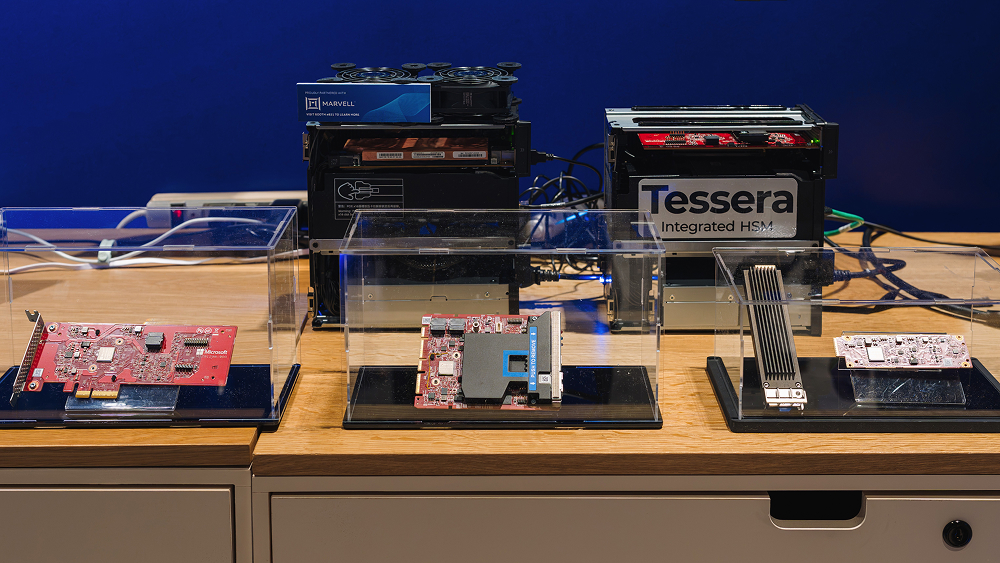
Tessera demonstration at the Microsoft OCP booth of the transfer protocols across a Tessera Integrated HSM and a Marvell LiquidSecurity 2 HSM, showing how two heterogeneous HSMs can operate in a resilient, unified security domain.
Tessera Highlights:
Tessera builds on the OCP tradition of collaborative innovation, bringing the industry together to develop open standards and interoperable security solutions. Launched by Marvell, Microsoft and Oracle through the OCP Security Project, Tessera extends the security ecosystem—in relation to Caliptra, although providing different functionality—beyond Root of Trust to address cryptographic services and key management at cloud scale.
###
This blog contains forward-looking statements within the meaning of the federal securities laws that involve risks and uncertainties. Forward-looking statements include, without limitation, any statement that may predict, forecast, indicate or imply future events or achievements. Actual events or results may differ materially from those contemplated in this blog. Forward-looking statements are only predictions and are subject to risks, uncertainties and assumptions that are difficult to predict, including those described in the “Risk Factors” section of our Annual Reports on Form 10-K, Quarterly Reports on Form 10-Q and other documents filed by us from time to time with the SEC. Forward-looking statements speak only as of the date they are made. Readers are cautioned not to put undue reliance on forward-looking statements, and no person assumes any obligation to update or revise any such forward-looking statements, whether as a result of new information, future events or otherwise.
Tags: HSMs, HSM services, HSM Applications, cloud-optimized HSMs, Security, AI, AI infrastructure, Cloud