


By Rajagopal Krishnaswamy, Associate Vice President, Product Marketing, Marvell
The networking industry has fully embraced the benefits of open networking. Organizations building cloud infrastructure, AI clusters, enterprise data centers and edge networks want the flexibility to choose the hardware and software solutions that best meet their requirements. Software for Open Networking in the Cloud (SONiC) has emerged as a powerful foundation for achieving that flexibility, enabling customers to adopt an open, community-driven network operating system across diverse environments.
But deploying SONiC in production requires more than installing software on a switch.
As networks grow in scale and complexity, organizations need validated software, operational visibility, lifecycle management, automation, and enterprise-grade support. Running modern infrastructure successfully requires a complete operational framework that helps teams deploy, manage, troubleshoot and evolve their networks over time.
That reality is driving the next phase of SONiC adoption.
By Michael Kanellos, Head of Influencer Relations, Marvell
The opportunity for custom silicon isn’t just getting larger – it’s becoming more diverse.
At the Custom AI Investor Event, Marvell executives outlined how the push to advance accelerated infrastructure is driving surging demand for custom silicon – reshaping the customer base, product categories and underlying technologies. (Here is a link to the recording and presentation slides.)
Data infrastructure spending is now slated to surpass $1 trillion by 20281 with the Marvell total addressable market (TAM) for data center semiconductors rising to $94 billion by then, 26% larger than the year before. Of that total, $55.4 billion revolves around custom devices for accelerated compute1. In fact, the forecast for every major product segment has risen in the past year, underscoring the growing momentum behind custom silicon.
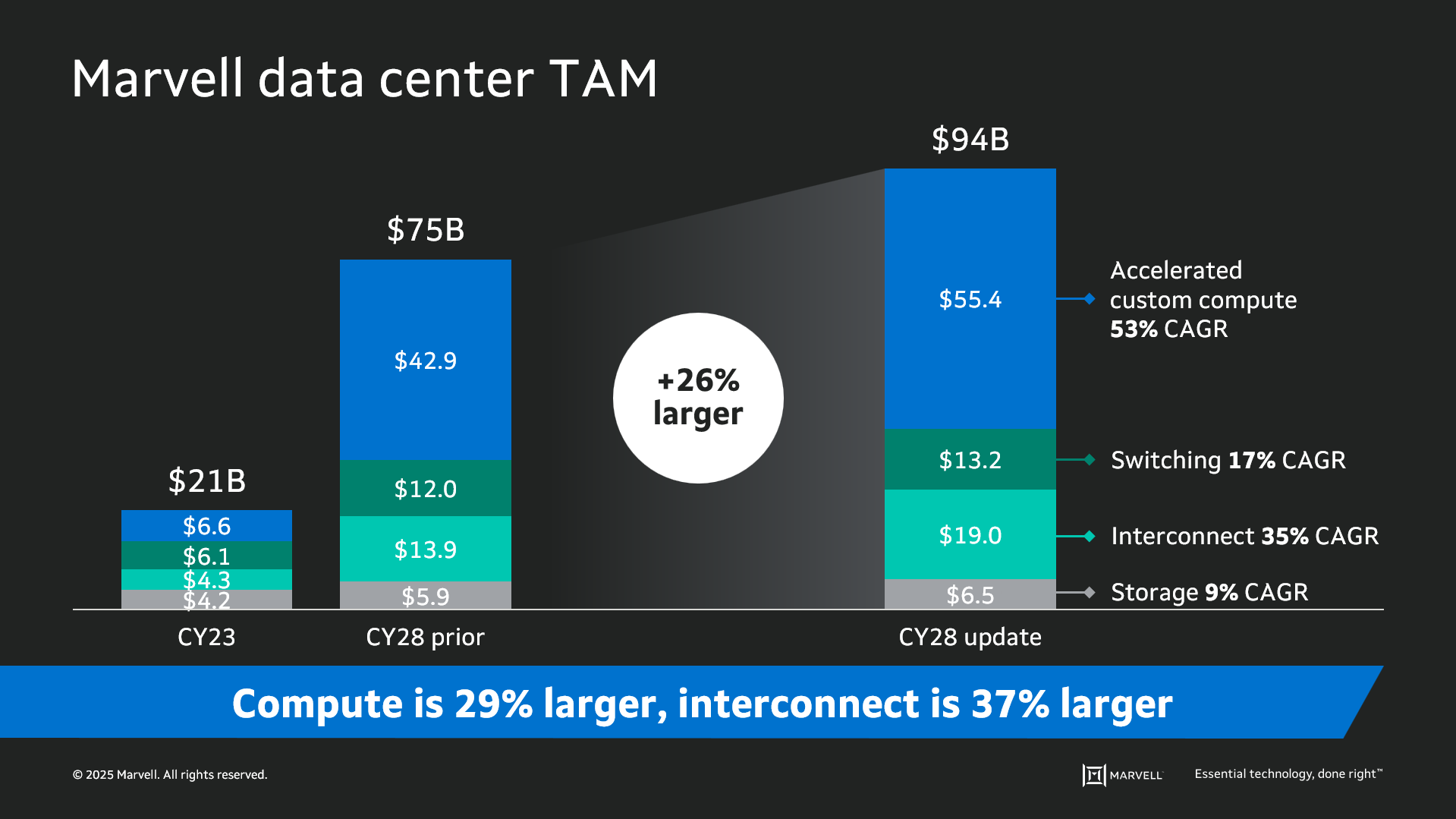
The deeper you go into the numbers, the more compelling the story becomes. The custom market is evolving into two distinct elements: the XPU segment, focused on optimized CPUs and accelerators, and the XPU attach segment that includes PCIe retimers, co-processors, CPO components, CXL controllers and other devices that serve to increase the utilization and performance of the entire system. Meanwhile, the TAM for custom XPUs is expected to reach $40.8 billion by 2028, growing at a 47% CAGR1.
By Michael Kanellos, Head of Influencer Relations, Marvell
You’re likely assaulted daily with some zany and unverifiable AI factoid. By 2027, 93% of AI systems will be able to pass the bar, but limit their practice to simple slip and fall cases! Next-generation training models will consume more energy than all Panera outlets combined! etc. etc.
What can you trust? The stats below. Scouring the internet (and leaning heavily on 16 years of employment in the energy industry) I’ve compiled a list of somewhat credible and relevant stats that provide perspective to the energy challenge.
1. First, the Concerning News: Data Center Demand Could Nearly Triple in a Few Years
Lawrence Livermore National Lab and the Department of Energy1 has issued its latest data center power report and it’s ominous.
Data center power consumption rose from a stable 60-76 terawatt hours (TWh) per year in the U.S. through 2018 to 176 TWh in 2023, or from 1.9% of total power consumption to 4.4%. By 2028, AI could push it to 6.7%-12%. (Lighting consumes 15%2.)
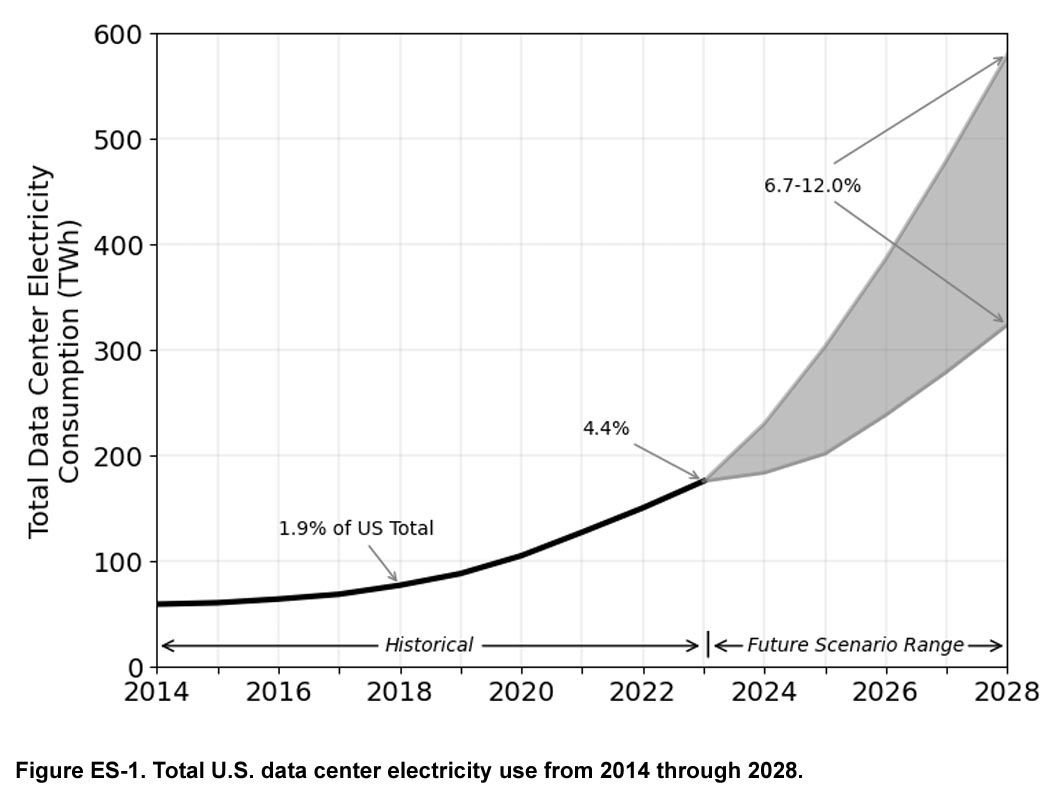
Report co-author Eric Masanet adds that the total doesn’t include bitcoin, which increases 2023’s consumption by 70 TWh. Add a similar 30-40% to subsequent years too if you want.
This article was originally published in VentureBeat.
Artificial intelligence is about to face some serious growing pains.
Demand for AI services is exploding globally. Unfortunately, so is the challenge of delivering those services in an economical and sustainable manner. AI power demand is forecast to grow by 44.7% annually, a surge that will double data center power consumption to 857 terawatt hours in 20281: as a nation today, that would make data centers the sixth largest consumer of electricity, right behind Japan’s2 consumption. It’s an imbalance that threatens the “smaller, cheaper, faster” mantra that has driven every major trend in technology for the last 50 years.
It also doesn’t have to happen. Custom silicon—unique silicon optimized for specific use cases—is already demonstrating how we can continue to increase performance while cutting power even as Moore’s Law fades into history. Custom may account for 25% of AI accelerators (XPUs) by 20283 and that’s just one category of chips going custom.
The Data Infrastructure is the Computer
Jensen Huang’s vision for AI factories is apt. These coming AI data centers will churn at an unrelenting pace 24/7. And, like manufacturing facilities, their ultimate success or failure for service providers will be determined by operational excellence, the two-word phrase that rules manufacturing. Are we consuming more, or less, energy per token than our competitor? Why is mean time to failure rising? What’s the current operational equipment effectiveness (OEE)? In oil and chemicals, the end products sold to customers are indistinguishable commodities. Where they differ is in process design, leveraging distinct combinations of technologies to squeeze out marginal gains.
The same will occur in AI. Cloud operators already are engaged in differentiating their backbone facilities. Some have adopted optical switching to reduce energy and latency. Others have been more aggressive at developing their own custom CPUs. In 2010, the main difference between a million-square-foot hyperscale data center and a data center inside a regional office was size. Both were built around the same core storage devices, servers and switches. Going forward, diversity will rule, and the operators with the lowest cost, least downtime and ability to roll out new differentiating services and applications will become the favorite of businesses and consumers.
The best infrastructure, in short, will win.
The Custom Concept
And the chief way to differentiate infrastructure will be through custom infrastructure that are enabled by custom semiconductors, i.e., chips containing unique IP or features for achieving leapfrog performance for an application. It’s a spectrum ranging from AI accelerators built around distinct, singular design to a merchant chip containing additional custom IP, cores and firmware to optimize it for a particular software environment. While the focus is now primarily on higher value chips such as AI accelerators, every chip will get customized: Meta, for example, recently unveiled a custom NIC, a relatively unsung chip that connects servers to networks, to reduce the impact of downtime.
By Ravindranath C Kanakarajan, Senior Principal Engineer, Switch BU
Marvell has been actively involved with SONiC since its beginning, with many SONiC switches powered by Marvell® ASICs at hyperscalers deployed worldwide. One of Marvell's goal has been to enhance SONiC to address common issues and optimize its performance for large-scale deployments.
The Challenge
Many hackathon projects have focused on improving the monitoring, troubleshooting, debuggability, and testing of SONiC. However, we believe one of the core roles of a network operating system (NOS) is to optimize the use of the hardware data plane (i.e., the NPUs and networking ASICs). As workloads become increasingly more demanding, it becomes crucial to maximize the efficiency of the data plane. Commercial black-box NOS are tailored to specific NPUs/ASICs to achieve optimal performance. SONiC, however, supports a diverse range of NPUs/ASICs, presenting a unique challenge.
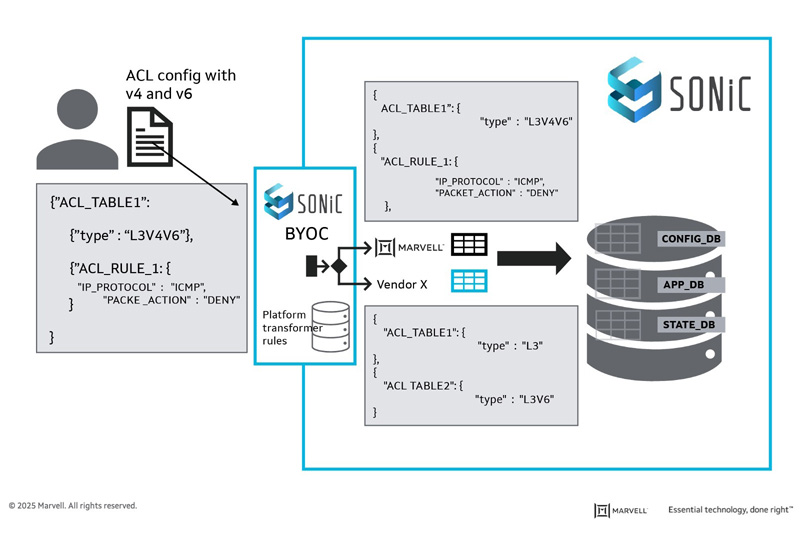
We at Marvell have been contributing features to SONiC to ensure optimal use of the underlying networking ASIC resources. Over time, we’ve recognized the need to provide operators with flexibility in utilizing ASIC resources while reducing the platform-specific complexity gradually being introduced into SONiC’s core component, the Orchagent. This approach will help SONiC operators to maintain consistent device configurations even when using devices from different platform vendors.
BYOC
During the Hackathon, we developed a framework called “BYOC: Bring Your Own Configuration,” allowing networking ASIC vendors to expose their hardware capabilities in a file describing intent. A new agent transforms the user’s configuration into an optimal SONiC configuration based on the capabilities file. This approach allows ASIC vendors to ensure that user configurations are converted to optimal ASIC configurations. It also allows SONiC operators to fine-tune the hardware resources consumed based on the deployment needs. It further helps in optimally migrating configurations from vendor NOS to SONiC based on the SONiC platform’s capability.