


By Vienna Alexander, Marketing Content Professional, Marvell

The Fast Mode Awards 2026 has recognized Marvell Photonic Fabric™ technology as an AI Compute Gamechanger for Impact. As a winner in the Data Center Solution Provider category, the award honors Marvell as a technology provider revolutionizing the next generation of data center capabilities and addressing the growing demands of the digital economy.
Memory capacity, bandwidth and connectivity are critical elements to consider in scale-up networks. With growing KV caches driving unprecedented memory demands, traditional architecture needs to adapt to create more efficient systems where processors can better access and move data across memory resources.
The Photonic Fabric technology platform enables more tightly integrated, high-bandwidth and power-efficient solutions for data center customers by creating pod-level optical shared memory.
By Arifur Rahman, Director of Product Marketing, Custom Cloud Solutions, Marvell
AI and ML workloads are rewriting the rules of data center design. Memory demands are reaching an unprecedented level due to growing LLM sizes, expanding context windows and growing KV-cache requirements. Traditional servers are not architected to meet this surge. Memory has become the primary bottleneck constraining AI performance and infrastructure efficiency. CXL-based memory expansion has emerged as one of the definitive architectural answers, and Marvell is raising the bar.
Building on the strong market adoption of the first-generation Structera® X CXL controllers, the second-generation Structera X 3406 and Structera X 3506, co-developed and co-architected with leading hyperscalers, address the most demanding AI infrastructure requirements.
Modern AI inference workloads, from LLM serving to deep learning recommendation models (DLRM), are memory bound. KV-cache capacity determines time-to-first-token (TTFT), throughput and XPU utilization. When memory runs out, performance collapses.
By Abed Mohammad Kamaluddin, Director, Custom Cloud Solutions, Marvell, and Vienna Alexander, Marketing Content Professional, Marvell
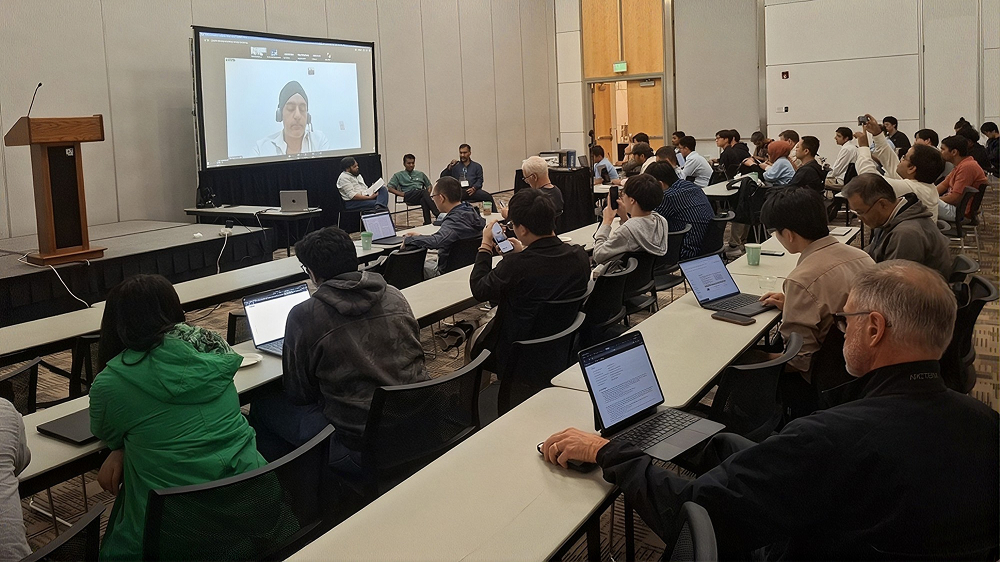
For most of the last decade, scaling AI meant scaling compute. If you built faster accelerators and wired enough of them together, the models would follow.
That is no longer the whole picture. Models now run to hundreds of billions of parameters with extensive context windows, and whether an expensive accelerator is working or just waiting comes down to memory: how much you have, how fast you can reach it, and how much time you lose moving data around.
Once memory leaves the server and rides a switched fabric, is it still memory, or has it become a network? This was the central question of MemNetAI, the first workshop on Memory-Semantic Networking for AI-Scale Systems, launched by Marvell with researchers from IIT Hyderabad and IIIT Delhi. Held at ACM SIGCOMM 2026 in Denver and guided by a program committee spanning academia and industry, it brought speakers from Cornell, alongside industry experts and researchers presenting their work, to debate these questions on the bleeding edge of AI infrastructure.
By Khurram Malik, Senior Director of Marketing, Custom Cloud Solutions, Marvell
Can AI beat a human at the game of twenty questions? Yes.
And can a server enhanced by CXL beat an AI server without it? Yes, and by a wide margin.
While CXL technology was originally developed for general-purpose cloud servers, the technology is now finding a home in AI as a vehicle for economically and efficiently boosting the performance of AI infrastructure. To this end, Marvell has been conducting benchmark tests on different AI use cases.
In December, Marvell, Samsung and Liqid showed how Marvell® StructeraTM A CXL compute accelerators can reduce the time required for conducting vector searches (for analyzing unstructured data within documents) by more than 5x.
In February, Marvell showed how a trio of Structera A CXL compute accelerators can process more queries per second than a cutting-edge server CPU and at a lower latency while leaving the host CPU open for different computing tasks.
Today, this blog post will show how Structera CXL memory expanders can boost performance of inference tasks.
By Khurram Malik, Senior Director of Marketing, Custom Cloud Solutions, Marvell
While CXL technology was originally developed for general-purpose cloud servers, it is now emerging as a key enabler for boosting the performance and ROI of AI infrastructure.
The logic is straightforward. Training and inference require rapid access to massive amounts of data. However, the memory channels on today’s XPUs and CPUs struggle to keep pace, creating the so-called “memory wall” that slows processing. CXL breaks this bottleneck by leveraging available PCIe ports to deliver additional memory bandwidth, expand memory capacity and, in some cases, integrate near-memory processors. As an added advantage, CXL provides these benefits at a lower cost and lower power profile than the usual way of adding more processors.
To showcase these benefits, Marvell conducted benchmark tests across multiple use cases to demonstrate how CXL technology can elevate AI performance.