



What do customers want from next-generation AI networks? Everything.
AI networks will need to manage exponentially more data across a rapidly expanding number of endpoints and evolving topologies, while reducing both cost and energy per bit. And, with data spending more than 30% of the time inside networks during training,1 congestion, transmission errors and other problems need to be kept to a minimum.
These networks will also need to be able to scale rapidly: AI networking spending is expected to reach $81.3 billion by 2030, more than 10x 2025 levels.2
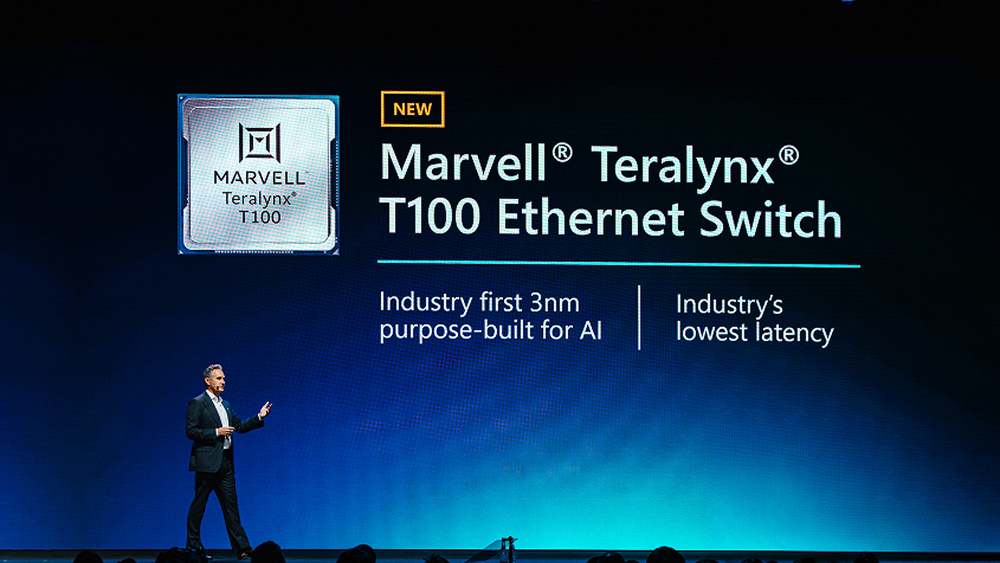
Marvell® Teralynx® T100, the new 3nm 102.4T data center switch ASIC, was architected from the ground up for the AI challenge. Through a unique design and feature set that reduces power consumption and complexity, Teralynx T100 delivers the industry’s lowest latency for AI training and inference workloads while reducing power consumption by up to 25% compared to competing solutions. A flexible connectivity architecture and 512-radix design minimizes networking tiers, equipment and complexity. The result is a highly versatile switch that can be used to optimize the performance and total cost of ownership for scale-up or scale-out networks.

While Teralynx T100 introduces several innovative features, let’s focus on three that fundamentally enhance the economics and performance of AI networking.
1. A Monolithic Design
Unlike other 102.4T switches, Teralynx T100 is designed around a single piece of silicon rather than a multi-die architecture. Multi-die designs lead to greater latency, bit error rates and power consumption because signals need to hop between the die in the package. And the more intense data traffic becomes, the more the benefits of a monolithic design get magnified.
Under normal workload conditions, the T100 will operate at a latency of approximately 400 nanoseconds—the lowest latency in this class, and even 20% lower than the 51.2T Marvell Teralynx 10 switch, the market-leader in latency for its class.3 Teralynx 100 will also deliver a deterministic latency—or an upper limit of latency over a sustained period of time—of under 420 ns.3 Lower latency directly reduces job completion time (JCT), an instrumental factor on TCO and ROI.
Teralynx T100 also uses up to 25% less power than competing solutions, consuming less than 1,000 watts under typical workload conditions thanks to its architecture and monolithic design. With these power savings, hyperscalers can thereby deploy more XPUs with the same power footprint.
Greater efficiency can also lower costs, making low-power switch silicon a strategic requirement. Switching and networking components consume approximately 15 to 25% of total rack power.4 Scale-out data center networking in the U.S. alone is expected to nearly double to 23 terawatt hours per year by 2028, according to Lawrence Berkeley National Laboratory.5 That’s as much power as EVs and plug-in hybrids combined consumed in the U.S. last year.6
2. Multiple Packaging and Connectivity Options
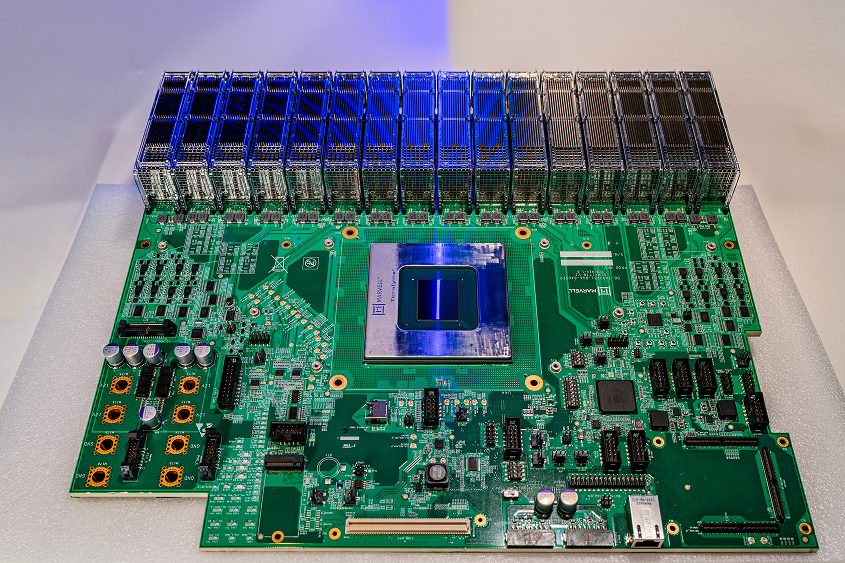
Customers now need to actively fine-tune fabrics for different use cases, applications and environments. As a result, Marvell is offering Teralynx T100 with different packaging solutions:
In the next several years, connectivity will revolve around experimentation, with CPO, CPC and BGA-based all co-existing in data centers. By supporting the full spectrum, Teralynx T100 enables customers to optimize network design while simplifying validation and deployment.
3. Programmability for Real-world Performance Gains
Even the most advanced designs can’t anticipate every contingency. Teralynx T100 is fully programmable to enable customers to fine-tune networks and adapt to specific workloads, traffic patterns, and architectures. Programmable features include:
A New Era of Networking
The rapid innovation and the evolution of new use cases make today one of the most exciting times in decades to be part of networking. As AI workloads continue to grow, expect continued advances from Marvell like Teralynx T100 to meet these evolving demands.
1. Meta keynote OCP Summit, reprinted via Marvell, February 2022
2. 650 Group. Accelerated and Programmable Data Center Ethernet Switch and Quarterly Report and Market Forecast, March 2026
3. Marvell internal estimates
4. SemiAnalysis, June 2024
5. U.S. Data Center Energy Usage Report, Lawrence Berkeley National Library, 2024
6. U.S. Energy Information Administration, Electric Power Monthly, March 2026
# # #
This blog contains forward-looking statements within the meaning of the federal securities laws that involve risks and uncertainties. Forward-looking statements include, without limitation, any statement that may predict, forecast, indicate or imply future events or achievements. Actual events or results may differ materially from those contemplated in this blog. Forward-looking statements are only predictions and are subject to risks, uncertainties and assumptions that are difficult to predict, including those described in the “Risk Factors” section of our Annual Reports on Form 10-K, Quarterly Reports on Form 10-Q and other documents filed by us from time to time with the SEC. Forward-looking statements speak only as of the date they are made. Readers are cautioned not to put undue reliance on forward-looking statements, and no person assumes any obligation to update or revise any such forward-looking statements, whether as a result of new information, future events or otherwise.