



By Annie Liao, Product Management Director, Connectivity, Marvell
PCIe has historically been used as protocol for communication between CPU and computer subsystems. It has gradually increased speed since its debut in 2003 (PCI Express) and after 20 years of PCIe development, we are currently at PCIe Gen 5 with I/O bandwidth of 32Gbps per lane. There are many factors driving the PCIe speed increase. The most prominent ones are artificial intelligence (AI) and machine learning (ML). In order for CPU and AI Accelerators/GPUs to effectively work with each other for larger training models, the communication bandwidth of the PCIe-based interconnects between them needs to scale to keep up with the exponentially increasing size of parameters and data sets used in AI models. As the number of PCIe lanes supported increases with each generation, the physical constraints of the package beachfront and PCB routing put a limit to the maximum number of lanes in a system. This leaves I/O speed increase as the only way to push more data transactions per second. The compute interconnect bandwidth demand fueled by AI and ML is driving a faster transition to the next generation of PCIe, which is PCIe Gen 6.
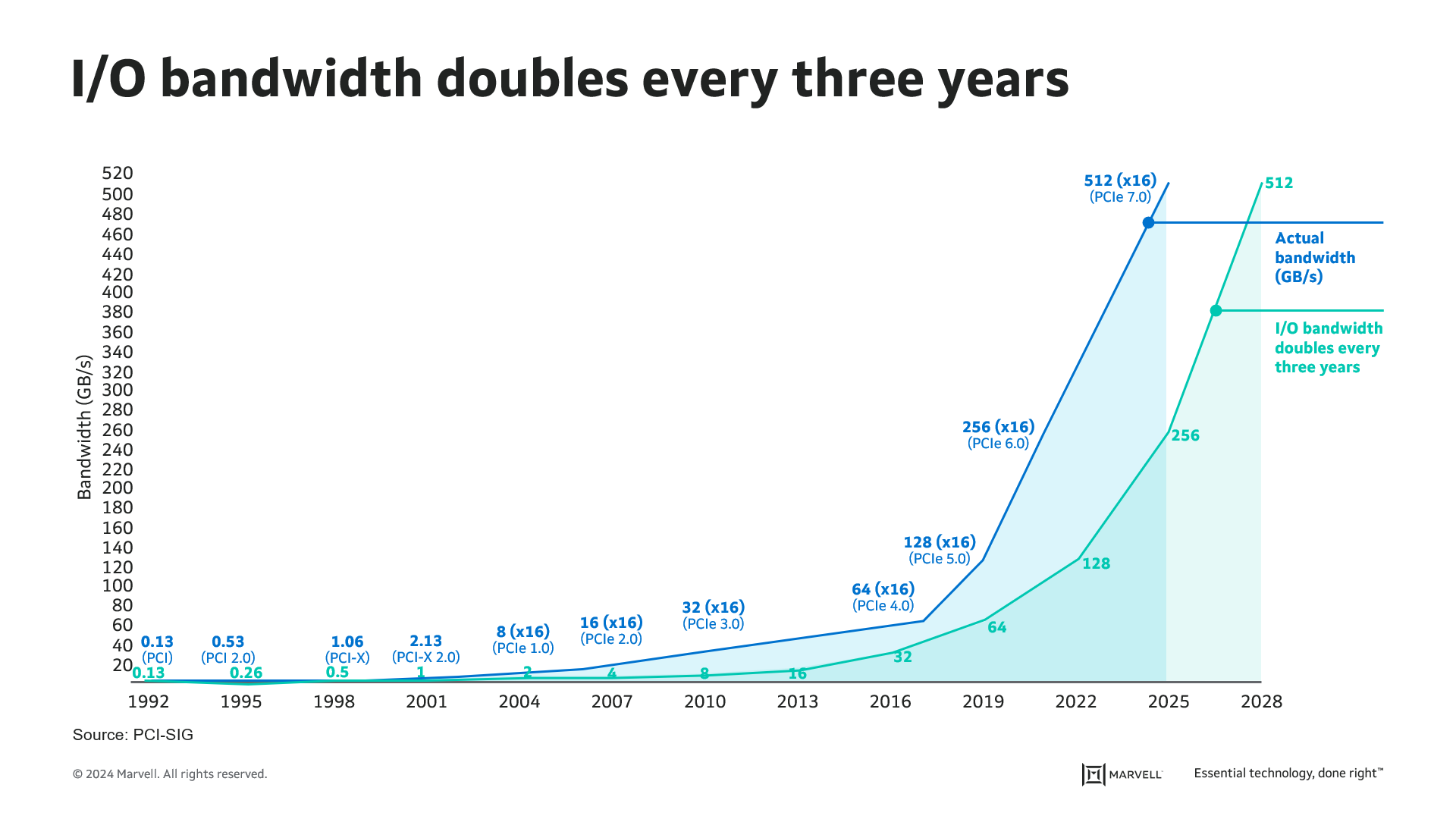
PCIe has been using 2-level Non-Return-to-Zero (NRZ) modulation since its inception. Increasing PCIe speed up to Gen 5 has been achieved through doubling of the I/O speed. For Gen 6, PCI-SIG decided to adopt Pulse-Amplitude Modulation 4 (PAM4), which carries 4-level signal encoding 2 bits of data (00, 01, 10, 11). The reduced margin resulting from the transition of 2-level signaling to 4-level signaling has also necessitated the use of Forward Error Correction (FEC) protection, a first for PCIe links. With the adoptions of PAM4 signaling and FEC, Gen 6 marks an inflection point for PCIe both from signaling and protocol layer perspectives.
In addition to AI/ML, disaggregation of memory and storage is an emerging trend in compute applications that has a significant impact in the applications of PCIe based interconnect. PCIe has historically been adopted on-board and for in-chassis interconnects. Attaching more front-facing NVMe SSDs is one of the common PCIe interconnect examples. With the increasing trends toward flexible resource allocation, and the advancement of CXL technology, the server industry is now moving toward disaggregated and composable infrastructure. In this disaggregated architecture, the PCIe end points are located at different chassis away from the PCIe root complex, requiring the PCIe link to travel out of the system chassis. This is typically achieved through direct attach cables (DAC) that can range up to 3-5m.
By Mary Gorges, Content Manager, Talent Branding, Marvell
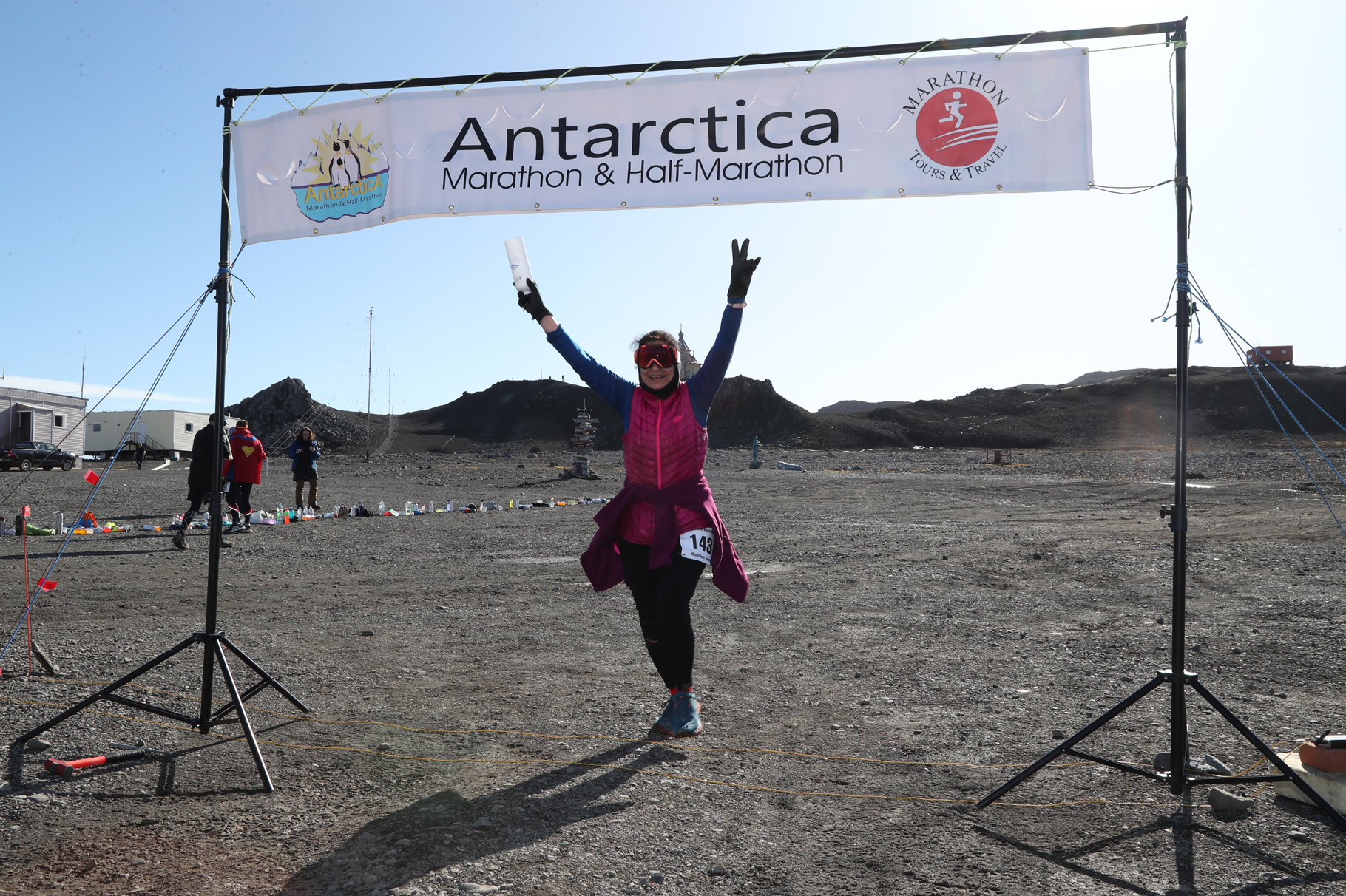
At Marvell, we celebrate the extraordinary experiences of our employees on a regular basis.
Recently, our own Anu Agrawal accomplished a remarkable feat by completing a half marathon in Antarctica. Once past the icy Drake Passage to travel there, Anu faced the most challenging running course of her life. Join us as we explore her awe-inspiring journey, highlighting the traits that drive her to conquer challenges and inspire others, both in and outside the workplace.
Just to reach her destination, Anu’s ship needed to cross the notorious Drake Passage, an icy expanse situated at the foot of South America. Alongside her fellow travelers, she encountered towering waves measuring 25 feet and beyond. The journey itself was challenging, and by the time Anu was ready to run, she had gone almost two weeks without engaging in any exercise. This extended hiatus from training added an extra layer of difficulty as she prepared to tackle the race.
Once underway, Anu found herself navigating a course that was hilly, gravelly and muddy, making it the toughest course she and many of her 150 fellow runners had ever experienced. The challenging conditions prompted several participants to switch from the full marathon to the 13-mile half marathon. Despite the real risk of hypothermia in the frigid Antarctic environment, Anu and the other runners remained undeterred. They embraced the tradition of the “polar plunge” into icy waters.
By Mari Escamilla, Engagement Manager, Marvell

No matter where in the world you might be, the words “I have a dream” probably sound familiar to you. This powerful phrase, once said by American civil rights leader Martin Luther King, Jr., is also the title of a speech he presented to millions in 1963, in which he called for equality for Black Americans. Standing on the steps of the Lincoln Memorial, he shared his vision of a free and just society, where people would be judged by their character and not the color of their skin.
60 years since that historic moment, his legacy continues to resonate with people today. Desmond Manford, Sr. HR Business Partner at Marvell, shared his reflections with us as we discussed King’s meaningful impact on society.
Growing up in Ghana, Africa, Desmond knew about Martin Luther King, Jr, but learned more about the civil rights leader's impact, sacrifice and vision as he lived and studied in the U.S. “I realized while nothing is perfect, some of the benefits I received were a direct result of the civil rights movement. Just the ability to be able to go to college - going through college was truly amazing,” shared Desmond.
As Desmond learned more, he felt inspired to do more – acting on his passion for volunteerism as a gesture of gratitude and honor for a leader and country that has done so much for him. Nestled in his community of Folsom, California is the Twin Lakes Food Bank, which provides food to those in need. Desmond is an active member of their leadership team, providing expertise in the field of people, performance, hiring, succession planning and other HR tasks. He invests his time in strengthening the organization by advocating for their mission, helping families access food, and searching for new ways to nurture the mental and physical health of those living in his community.
By Mary Gorges, Content Manager, Talent Branding, Marvell
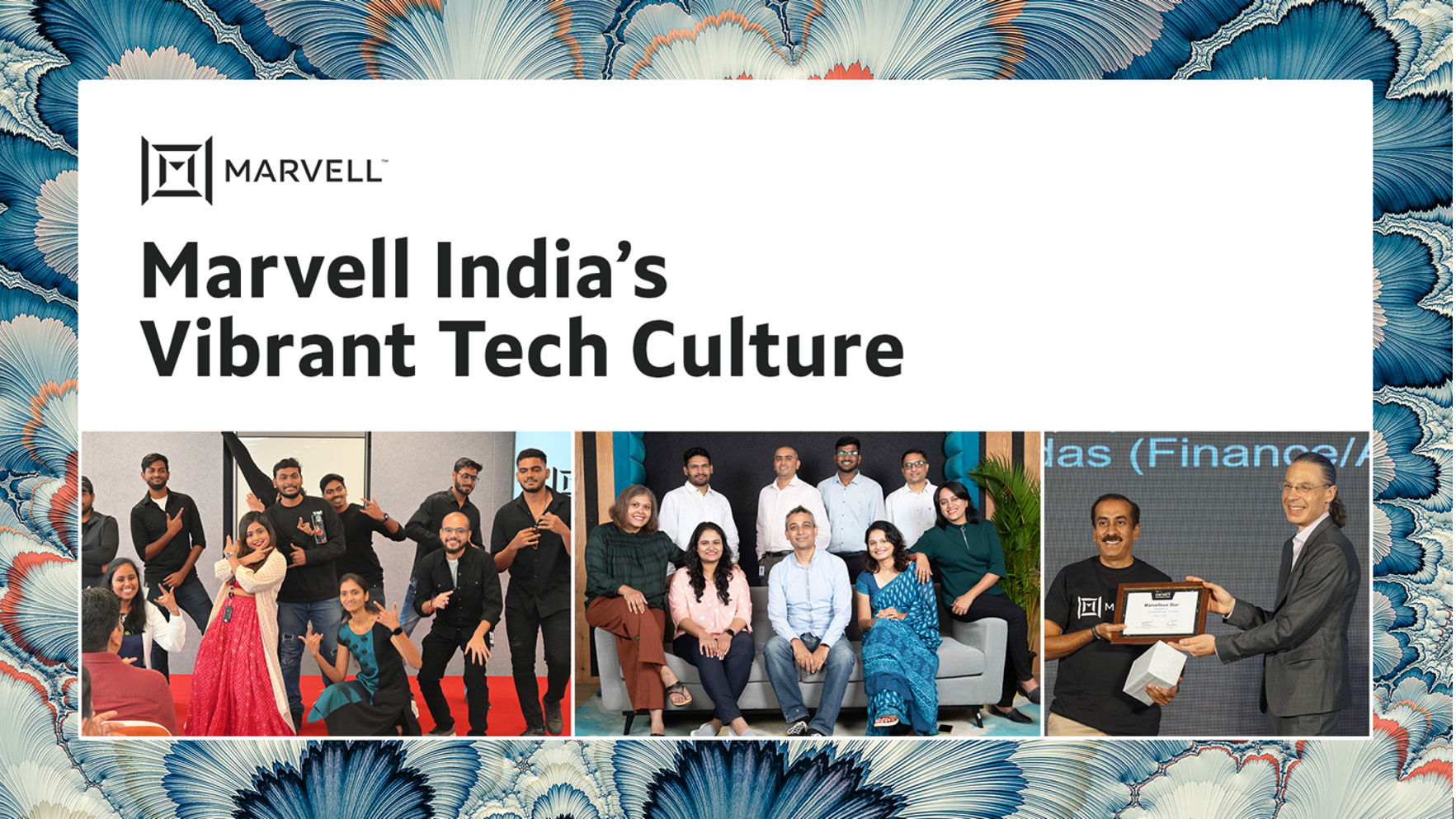
Country Manager Navin B. describes the unique engineering culture thriving within Marvell India as stemming from its ingrained diversity. “Marvell India thrives on a blend of backgrounds – diverse regions, ethnicities, skill levels, languages, and gender. And while all of Marvell India is geographically apart from corporate headquarters in California, this leads to even more nurturing of collaboration.”
Navin notes, however, that nearly 25 percent of the world's fabless design engineers are in India, a key factor in having Marvell's large Design Center there. He adds, “When we talk to candidates about why Marvell India, we highlight first, that we’re enabling the silicon data infrastructure of the future, and secondly, that we are located in the middle of a tech hub which includes our customers and partners, and we take great pride in that.”
Marvell's India Design Center spans four sites – in Bangalore, Pune, Hyderabad, and Chennai, each unique in scale and character – yet collectively contributing to the richness of Marvell's diversity. The Bangalore site is the largest with over 1,000 employees.