



By Vienna Alexander, Marketing Content Professional, Marvell
Marvell is proud to celebrate its 10th consecutive year as the “Fittest Firm” in the Silicon Valley Turkey Trot. Since 2016, Marvell has sponsored the competition and consistently earned this distinction for having the highest employee participation among large firms.
The Silicon Valley Turkey Trot is the largest Thanksgiving Day race in the United States. Embracing the spirit of giving, the event donates all proceeds to four local non-profit organizations: Healthier Kids Foundation, HomeFirst, Second Harvest of Silicon Valley, and Second Harvest. The race has contributed more than $13 million and provided more than 10 million meals to these causes since its inception in 2005.
This year, on Thanksgiving morning, more than 700 Marvell employees and their families joined the race to support these local organizations and stay active during the holiday season.
“We’re incredibly proud to have so many employees participate in this meaningful event year after year,” said Chris Koopmans, Marvell President and Chief Operating Officer. “Marvell has supported the Silicon Valley Turkey Trot for a long time, and we’re honored to contribute to such worthwhile organizations in our community. We care deeply about promoting physical and mental well-being, and it’s inspiring to see our team come together in support of such an important cause.”
By Vienna Alexander, Marketing Content Professional, Marvell

Optical connectivity is the backbone of AI servers and an expanding opportunity where Marvell shines, given its comprehensive optical connectivity portfolio.
Marvell showcased its notable developments at ECOC, the European Conference on Optical Communication, alongside various companies contributing to the hardware needed for this AI era.
Learn more about these impactful optical innovations that are enabling AI infrastructure, plus the trends and goings-on of the market.
By Chander Chadha, Director of Marketing, Flash Storage Products, Marvell
AI is all about dichotomies. Distinct computing architectures and processors have been developed for training and inference workloads. In the past two years, scale-up and scale-out networks have emerged.
Soon, the same will happen in storage.
The AI infrastructure need is prompting storage companies to develop SSDs, controllers, NAND and other technologies fine-tuned to support GPUs—with an emphasis on higher IOPS (input/output operations per second) for AI inference—that will be fundamentally different from those for CPU-connected drives where latency and capacity are the bigger focus points. This drive bifurcation also likely won’t be the last; expect to also see drives optimized for training or inference.
As in other technology markets, the changes are being driven by the rapid growth of AI and the equally rapidly growing need to boost the performance, efficiency and TCO of AI infrastructure. The total amount of SSD capacity inside data centers is expected to double to approximately 2 zettabytes by 2028 with the growth primary fueled by AI.1 By that year, SSDs will account for 41% of the installed base of data center drives, up from 25% in 2023.1
Greater storage capacity, however, also potentially means more storage network complexity, latency, and storage management overhead. It also means potentially more power. In 2023, SSDs accounted for 4 terawatt hours of data center power, or around 25% of the 16 TWh consumed by storage. By 2028, SSDs are slated to account for 11TWh, or 50%, of storage’s expected total for the year.1 While storage represents less than five percent of total data power consumption, the total remains large and provides incentives for saving. Reducing storage power by even 1 TWh, or less than 10%, would save enough electricity to power 90,000 US homes for a year.2 Finding the precise balance between capacity, speed, power and cost will be critical for both AI data center operators and customers. Creating different categories of technologies becomes the first step toward optimizing products in a way that will be scalable.
By Vienna Alexander, Marketing Content Professional, Marvell
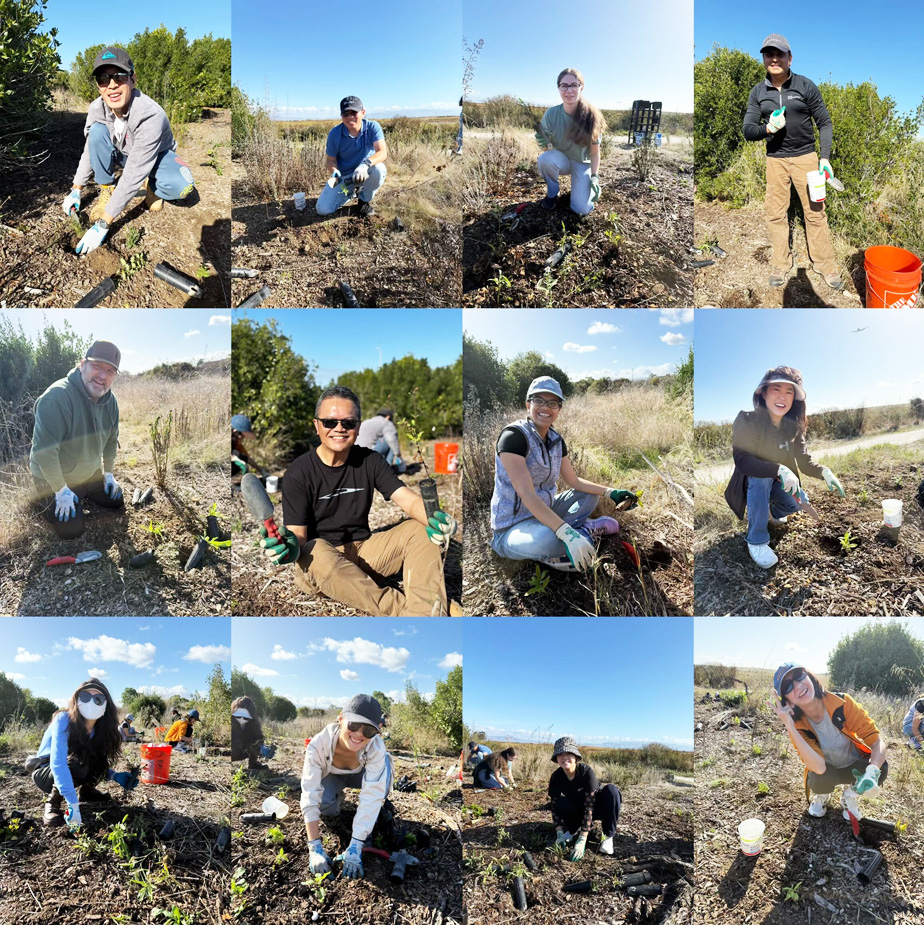
Earlier this month, Marvell employees came together for a hands-on volunteer day at Palo Alto Baylands, partnering with Save The Bay—a local environmental nonprofit dedicated to restoring and protecting the Bay’s vital habitats. Guided by two project leaders from Save The Bay, the Marvell team planted 837 native plants representing 10 different species across two restoration sites. This effort not only strengthened the Bay’s resilience to climate change and sea-level rise, but also fostered teamwork and community spirit among colleagues.
By Benjamin Reyes, Director, Analog Design, Marvell
On top of my day job as a director of Analog Design, I teach analog design at the university level.
When Marvell recruiter Fernanda Bustos reached out and asked me to share my expertise in analog design at the Marvell Summer Intern Program—a two-week analog design course—I was thrilled. It proved to be such a valuable experience.
The interns were fully invested in and focused on their studies, which provided a unique opportunity to dive deep into the subject matter. It was incredibly rewarding to see their dedication to learning and I was inspired by their enthusiasm for the field.
Amplifying Talent
I’ve always enjoyed teaching young engineers, so the opportunity to mentor a new generation of talent was something I was eager to embrace.
For me, mentoring is more than just sharing my knowledge; it’s all about giving back to the community and helping shape professionals who will be leading this industry in the future. Seeing their excitement and commitment to their growth was one of the most rewarding aspects of the experience.