



The exponential growth in AI workloads drives new requirements for connectivity in terms of data rate, associated bandwidth and distance, especially for scale-up applications. With direct attach copper (DAC) cables reaching their limits in terms of bandwidth and distance, a new class of cables, active copper cables (ACCs), are coming to market for short-reach links within a data center rack and between racks. Designed for connections up to 2 to 2.5 meters long, ACCs can transmit signals further than traditional passive DAC cables in the 200G/lane fabrics hyperscalers will soon deploy in their rack infrastructures.
At the same time, a 1.6T ACC consumes a relatively miniscule 2.5 watts of power and can be built around fewer and less sophisticated components than longer active electrical cables (AECs) or active optical cables (AOCs). The combination of features gives ACCs a peak mix of bandwidth, power, and cost for server-to-server or server-to-switch connections within the same rack.
Marvell announced its first ACC linear equalizers for producing ACC cables in October 2025..
Inside the Cable
ACCs effectively integrate technology originally developed for the optical realm into copper cables. The idea is to use optical technologies to extend bandwidth, distance and performance while taking advantage of copper’s economics and reliability. Where these ACCs differ is in the components added to them and the way they leverage the technological capabilities of a switch or other device to which they are connected.
ACCs include an equalizer that boosts signals received from the opposite end of the connection. As analog devices, ACC equalizers are relatively inexpensive compared to digital alternatives, consume minimal power and add very little latency.
By contrast, AECs incorporate digital signal processors (DSPs) at each end of the cable that work to maintain signal integrity during both transmission and reception. While providing greater signal processing capabilities and longer distance, AECs also consume more power and add more latency. Marvell and cable partner Infraeo, for instance, showed a 9-meter AEC cable operating at 800G. At that distance, it becomes possible to create a scale-up system that transcends seven racks, or nearly a complete data center row.
AOCs, meanwhile, incorporate DSPs, transimpedance amplifiers, and drivers into an optical fiber cable for distances up to 30 meters, albeit at a higher power budget, as data center clusters increase in size and longer distances at 200G/lane beyond 5 meters are required.
As a result, cable selection depends on the use case. The diversity of cable options gives the ability to improve total cost of ownership and return on investment that were not available in the past. Data center developers can select rack connectivity solutions based on power, cost and distance needed, since all these copper technologies will be co-existing in scale-up applications.
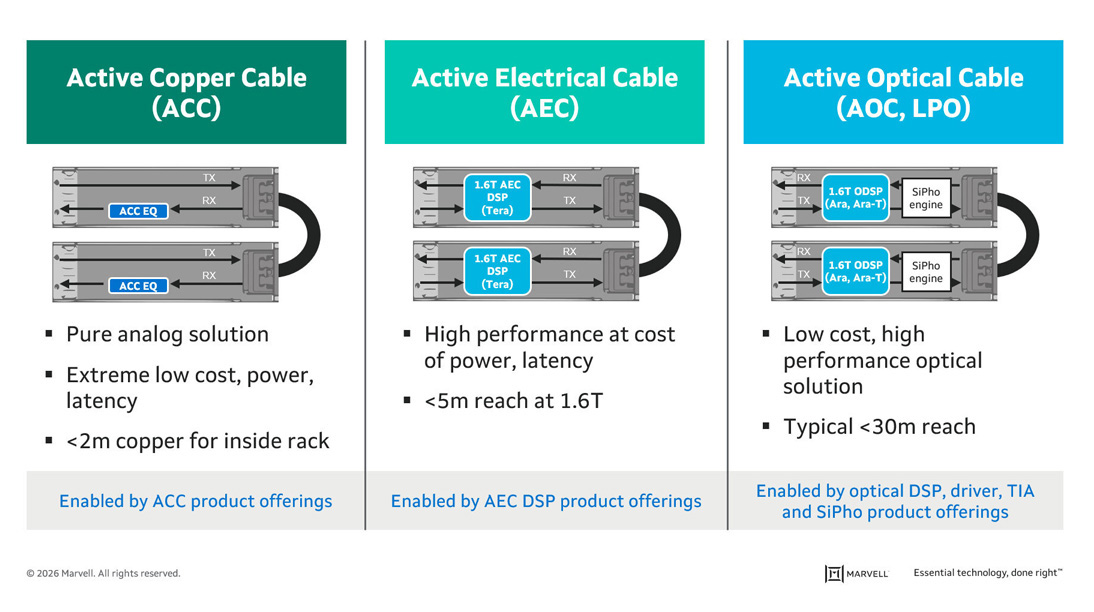
Which cable for scaling data centers? It depends on the reach, power, cost and bandwidth. While the different varieties of cables may only vary by a few watts, hyperscalers will deploy millions of them across infrastructures.
ACCs can also leverage the switch to reduce signal loss. A 32-gauge ACC usually comes with up to 45dB of loss, depending on cable specs and fixture design. The ACCs powered by the Marvell CB11208 equalizer provide up to 20dB of equalization. The rest comes from the switch.
Including only the amplifier into the cable further simplifies cable design, which in turn helps to expand the number of manufacturers that can participate in the market.
By leveraging its in-house analog and digital technology, Marvell offers ACCs, AECs and AOCs as a comprehensive solution for data center rack connectivity.
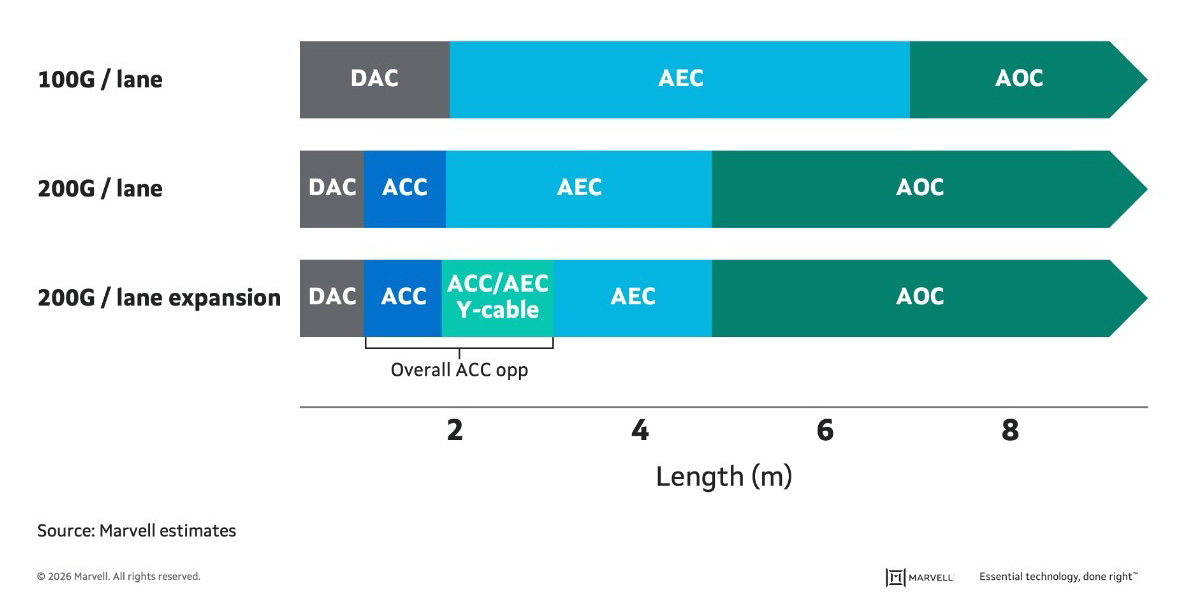
As bandwidth doubles, effective cable length decreases.
The Cambrian Era of Interconnects
ACCs are the latest edition to the growing diversity of interconnects. To keep up with the escalating performance demands of AI clusters and general-purpose cloud infrastructure, interconnect companies are pioneering new product categories for data infrastructure fabrics.
The idea is to give data center architects and operators a broad spectrum of solutions for reducing downtime, increasing bandwidth, cutting power, elevating return on investment and fine-tuning every aspect of their operations to a high degree.
Some of the new product categories that have emerged in recent years include:
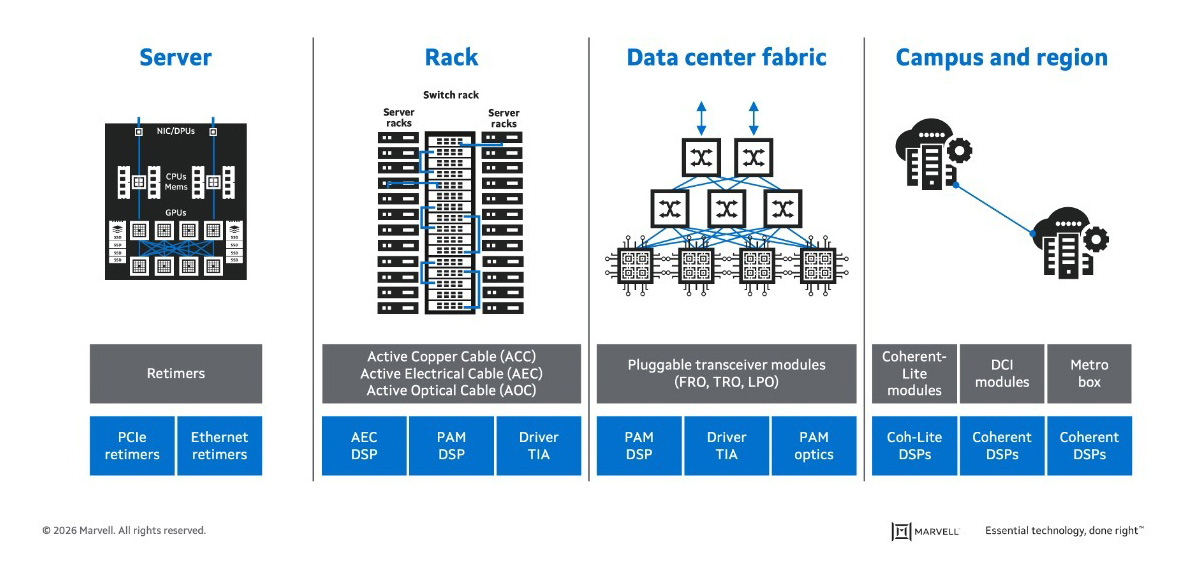
Copper to optical: as the need for performance grows, the diversity of cables expands. Interconnect solutions will include both copper and optical and extend in reach from millimeters (to connect chips on a board) to miles (to connect distant data centers) to suit multiple use cases.
# # #
This blog contains forward-looking statements within the meaning of the federal securities laws that involve risks and uncertainties. Forward-looking statements include, without limitation, any statement that may predict, forecast, indicate or imply future events or achievements. Actual events or results may differ materially from those contemplated in this blog. Forward-looking statements are only predictions and are subject to risks, uncertainties and assumptions that are difficult to predict, including those described in the “Risk Factors” section of our Annual Reports on Form 10-K, Quarterly Reports on Form 10-Q and other documents filed by us from time to time with the SEC. Forward-looking statements speak only as of the date they are made. Readers are cautioned not to put undue reliance on forward-looking statements, and no person assumes any obligation to update or revise any such forward-looking statements, whether as a result of new information, future events or otherwise.
Tags: Optical Interconnect, data center interconnect, Active Electrical Cables, networking in data centers, networking for AI training workloads